Use Apppricer Data to Set Subscription Price Points for Developers

Start with three tiers built around a value metric your users actually feel, then layer in usage or hybrid pricing only if your costs scale with consumption. That’s the pragmatic starting architecture for most mobile apps in 2026. Before locking numbers, check four things: who your segments are, what each user costs you to serve, your target LTV/CAC ratio, and whether billing should run monthly, annual, or both. American consumers already spend an average of $90 a month across subscriptions, and Apple’s own pricing API gives you the territory-level data to price against that reality instead of guessing.
TL;DR:
- Use a three-tier, value-based pricing structure first, layering in usage or hybrid models only if costs scale with consumption.
- Choose a subscription model carefully, with tiered pricing being most common, while avoiding flat rate or per-user models that may limit revenue or applicability.
- Conduct user segmentation and willingness-to-pay tests before setting prices, and set clear thresholds for renewal, upgrades, and cancellations, including local tax compliance.
- Benchmark prices against real competitors using territory-specific data and adjust tiers to reflect actual market and usage patterns, avoiding guesswork.
- Measure critical metrics such as churn, upgrade rate, and ARPU over multiple billing cycles to validate price changes, and run controlled experiments before making significant adjustments.
Table of Contents
- What Are the Main Subscription Pricing Models?
- How Do You Choose the Right Subscription Price Point?
- How Should You Test New Price Points Before Launch?
- What Metrics Actually Tell You If a Price Change Worked?
- Where Should Your Pricing Data Actually Come From?
- What Legal and Compliance Rules Apply to Subscription Pricing?
- How Do Price Points Affect Acquisition and Retention?
- How Do You Benchmark Your Pricing Against Competitors?
- Map Your Price Points With Apppricer
- Three Things I’ve Learned Pricing Mobile Apps
- Sources
What Are the Main Subscription Pricing Models?
Six models cover almost every app on the market, and picking the wrong one is the single most expensive mistake a developer can make before writing a line of billing code.
Flat rate charges one price for full access, no matter how much someone uses the app. It’s the simplest to build and explain, which is why habit-tracking and journaling apps lean on it. The downside: power users and light users pay the same, so you leave money on the table with your heaviest fans.
Tiered pricing splits the product into two or three packages (say, Basic, Pro, and Premium), each unlocking more features or higher limits. It’s the most common structure in SaaS today because it gives users a clear upgrade path without forcing a redesign every time you add a feature.
Per-user pricing charges by seat, which works well for team or collaboration apps but falls apart for consumer products where “seats” don’t make sense.
Usage-based pricing ties cost to consumption: API calls, storage, generated images, minutes of video processed. It aligns revenue with your actual infrastructure cost, but it makes budgeting unpredictable for the customer, which can suppress conversion if you don’t cap it.
Freemium gives away a working core product and charges for advanced features. It’s a strong acquisition engine, but only if your free-to-paid conversion rate is high enough to fund the free users riding along, according to Chargebee’s analysis of freemium versus trial models.
Hybrid pricing combines a base subscription fee with usage charges on top. Stripe’s guide to subscription models frames this as the model to reach for when your product has both a stable core value and a variable cost driver, and it’s currently the fastest growing approach among the six.
- Flat rate: lowest complexity, weakest revenue capture from heavy users
- Tiered: predictable revenue, moderate build effort, clear upgrade psychology
- Per-user: strong for B2B collaboration, poor fit for solo consumer apps
- Usage-based: cost-aligned, but volatile and harder for users to budget around
- Freemium: powerful acquisition funnel, risky without a strong conversion rate
- Hybrid: best of tiered stability and usage upside, but the hardest to explain in one sentence
How Do You Choose the Right Subscription Price Point?
Picking numbers before you understand your customers is how most apps end up chasing a pricing “reset” eighteen months in. Work through this sequence instead.
- Segment your users and test willingness to pay. Run a Van Westendorp price sensitivity survey or a quick micro-survey against your existing user base before writing a single price into your billing system. This narrows your acceptable range long before you risk a live experiment, a method documented in subscription business model guides as a reliable first filter.
- Set your unit economics constraints. Decide your target LTV/CAC ratio, minimum margin buffer, and ARPU goal before designing tiers. If your infrastructure cost per user varies widely, that’s your signal to add a usage component rather than force everyone into one flat number.
- Design three tiers with anchor pricing. NetSuite’s framework for choosing a subscription architecture stresses matching tier count to product usage patterns and your team’s resources to maintain them. A low anchor tier, a middle tier built to carry most of your revenue, and a high tier for your most engaged users covers the range without overwhelming a new customer with choices.
- Set your monthly versus annual discount guardrail. A moderate discount for annual commitment is the common range that rewards commitment without gutting your monthly ARPU.
Pro Tip: Cap yourself at three tiers, and differentiate them with meaningful feature anchors, not tiny incremental usage limits. “50 exports versus 75 exports” doesn’t sell an upgrade. “Team collaboration” or “priority support” does.
If you want a packaging reference for how clean tier presentation looks in practice, Cairrot’s pricing page is a useful example of anchor pricing done without clutter.
How Should You Test New Price Points Before Launch?
Structure the rollout as a controlled experiment with a defined exit if things go wrong.
Design an A/B or cohort test where you vary one thing at a time. Testing three price points against three feature bundles simultaneously produces noise you can’t interpret. Hold your sample size to a level where you can detect a meaningful shift in conversion, not just a directional hint. Narrow your range first using Van Westendorp or a targeted survey so your live test is validating a hypothesis, not exploring blind.
Before you flip the switch, run through an operational checklist:
- Confirm proration logic for users switching mid-cycle
- Check local tax and receipt handling for every territory you sell in
- Map your new price against Apple’s subscription price points API so your territory-level customerPrice and proceeds line up correctly
- Set trial length and confirm your upgrade messaging matches the new tier structure
Measure conversion, retention, and upgrade rate through at least one full billing cycle. Set a rollback threshold in advance. If retention drops sharply for a cohort within the first week, that’s your signal to pull back before the damage compounds across a full month of renewals.
What Metrics Actually Tell You If a Price Change Worked?
A pricing change looks successful in week one and disastrous in month three more often than developers expect. Track these core numbers on a fixed cadence, not just when something feels off:
- MRR (monthly recurring revenue), tracked in aggregate and by plan
- ARPU (average revenue per user), which should rise after a well-designed tier change
- Churn by cohort and plan, since a price increase often hits new signups differently than existing users
- Upgrade rate, the clearest signal that your tier anchors are working
- LTV and CAC, watched together, not separately
- Net revenue retention (NRR), which captures expansion and contraction in one number
Check results at 7 days, 30 days, and 90 days. Early churn spikes and a flat distribution across plans (everyone stuck on your cheapest tier) are both signs your pricing isn’t doing its job. Recurly’s pricing playbook treats pricing as a lifecycle lever rather than a one-time decision, arguing that plan distribution and renewal behavior reveal mispricing faster than raw conversion numbers alone.
Statistic Callout: Subscription businesses that analyze churn signals by cohort, rather than as one blended number, can identify pricing problems earlier, according to Recurly’s playbook analysis.
Where Should Your Pricing Data Actually Come From?
Guesswork is the enemy of good pricing, and the developers who get it right are pulling from a specific stack of sources rather than intuition. Apple’s subscription price points API gives you the territory-by-territory data on customerPrice, proceeds, and equalizations you need before you set a single number. Vendor guides from Stripe and NetSuite lay out the architectural choices. Your own telemetry tells you where usage actually concentrates. And market benchmarks tell you what buyers already expect to pay.
This is exactly the gap Apppricer closes for app developers and growth managers. It aggregates actual app prices and subscription structures across 175 countries, so you can see what competitors charge in each territory rather than estimating from a handful of markets.
- Spot underpriced tiers by comparing your price points against category leaders in the same territory
- Model revenue impact on ARPU and MRR before committing to a live price change
- Pull exportable, equalized price points to plan a territory rollout without manually converting currencies and tax treatments one country at a time
Sergey, who has spent years analyzing app monetization data across hundreds of markets, points to a recurring pattern: developers who cross-reference their planned price against real competitor data catch mispricing before launch, not three months into a churn problem.
What Legal and Compliance Rules Apply to Subscription Pricing?
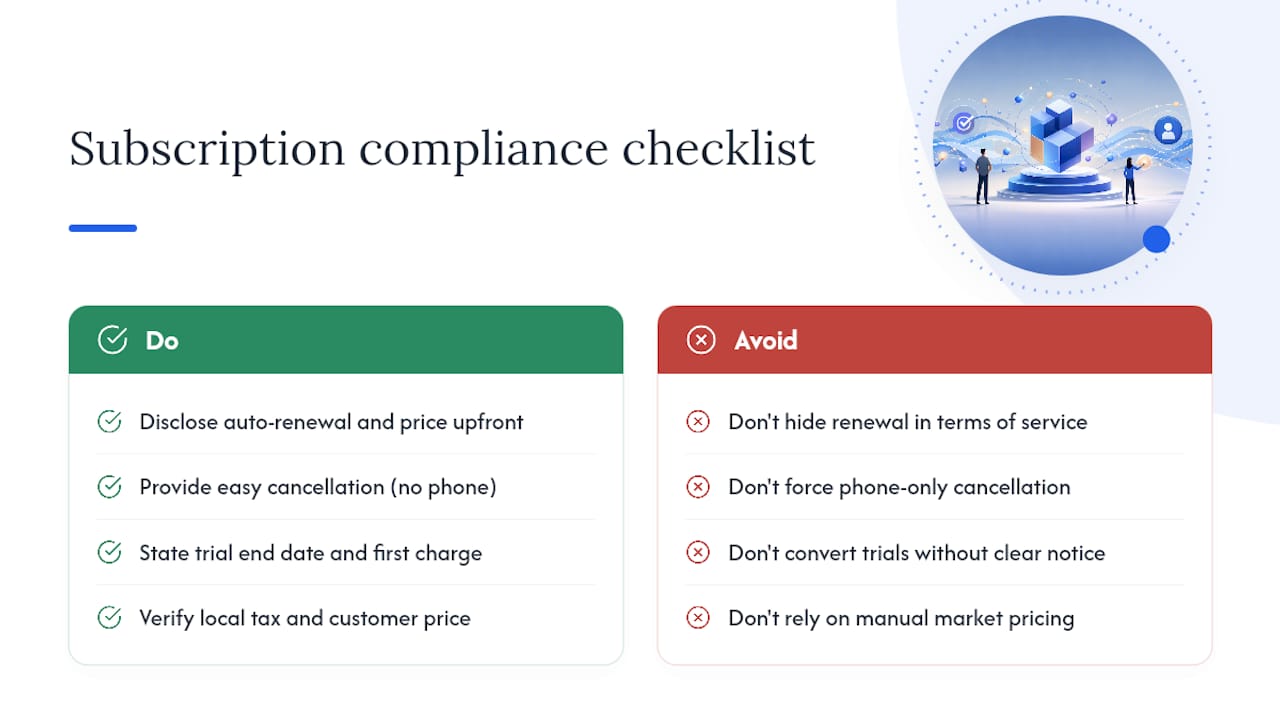
Subscription pricing sits inside a growing web of consumer protection rules, and the requirements vary sharply by country and platform. Auto-renewal disclosure is the most consistent thread. Many jurisdictions require clear, upfront notice that a subscription will renew automatically and at what price, along with an easy cancellation path that doesn’t force a phone call or hidden menu.
Trial-to-paid conversion carries its own scrutiny. Regulators in several markets have penalized apps for converting free trials to paid subscriptions without a clear reminder before the charge hits. Your trial messaging needs to state the exact date and amount of the first charge, not burying it in terms of service.
Tax treatment differs by territory too. Apple’s price points system handles VAT and local tax inclusion differently depending on the country, which is part of why manually setting prices market by market is error prone. Price equalization data from Apple’s API accounts for this automatically at the territory level, but you still need to verify the resulting customer-facing price matches local disclosure requirements.
None of this is a substitute for legal review specific to the countries where you operate, especially the European Union’s consumer protection rules around subscription contracts and the growing number of U.S. states with “click to cancel” requirements. Treat compliance as a design constraint from the start, not a fix applied after a regulator flags your app.
How Do Price Points Affect Acquisition and Retention?
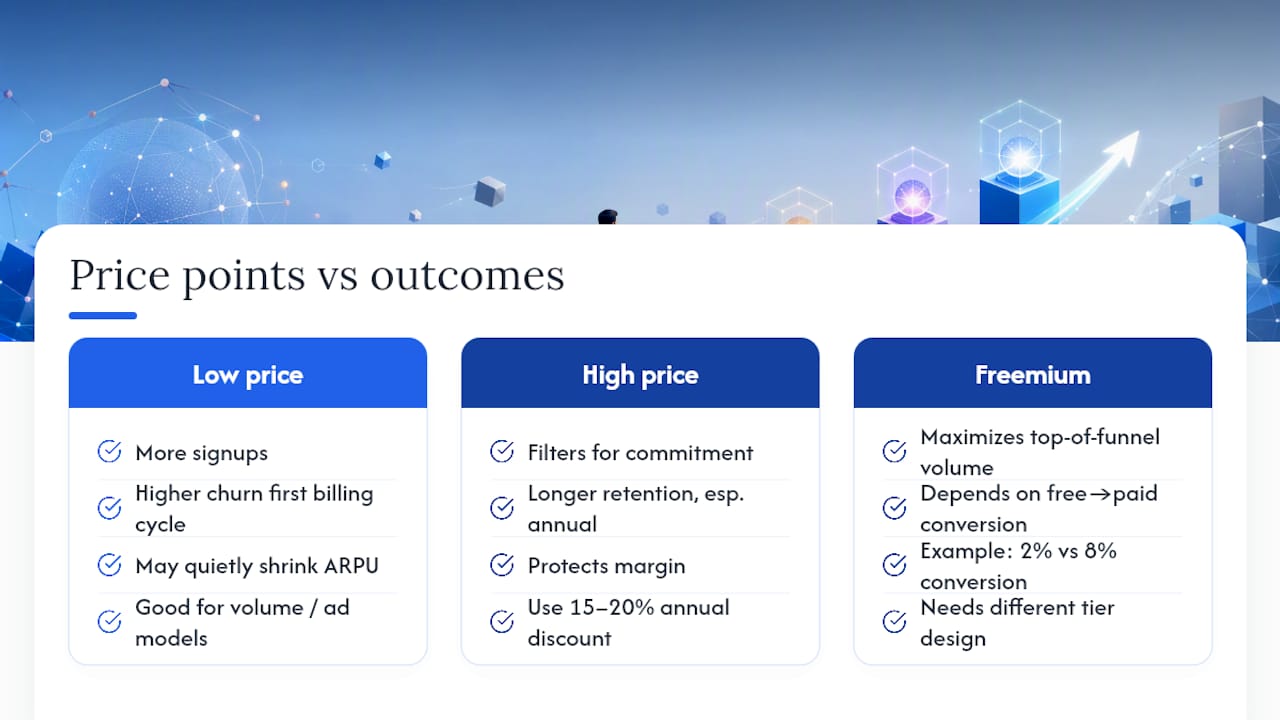
A lower price point pulls in more signups, but it also often pulls in users with lower intent, and that shows up in your churn numbers within the first billing cycle. The relationship isn’t linear. Dropping your price by 20% doesn’t guarantee 20% more paying users, and it can quietly shrink your ARPU without meaningfully improving retention.
Higher price points tend to filter for commitment. Users who pay more upfront, especially on annual plans, usually stick around longer because they’ve already made a bigger decision to commit. That’s part of why the 15% to 20% annual discount guardrail matters: it nudges genuinely interested users toward a plan structure that reduces monthly cancellation friction, without discounting so deeply that you erode margin.
Freemium sits in a different category entirely. It optimizes for top-of-funnel volume, and its success depends entirely on whether your free-to-paid conversion rate can support the users who never pay. A freemium app with a 2% conversion rate needs a very different tier design than one converting at 8%.
The practical takeaway: match your price point to the retention behavior you actually want. If you need volume for network effects or ad revenue, price low and design monetization around a smaller paying subset. If you need a sustainable subscription business without ad support, a higher anchor price with strong onboarding will usually outperform a race to the bottom on price.
How Do You Benchmark Your Pricing Against Competitors?
Benchmarking subscription pricing without visibility into what your direct competitors actually charge is close to flying blind. Public app store listings show you list prices, but they rarely show you how those prices vary by territory, what trial structures competitors run, or how pricing has shifted over time.
Start by identifying your true competitive set, not just apps in the same category, but apps solving the same core problem for the same buyer. A meditation app competes with other meditation apps, but it might also compete with a broader wellness subscription bundle. Map their tier structures: how many tiers, what feature gates sit between them, and where their price anchors land relative to the market.
Territory-level comparison matters more than most developers assume. A price that looks competitive in the United States might be significantly overpriced or underpriced once converted and compared against local purchasing power in a market like Brazil or India. This is where aggregated pricing data across multiple countries becomes genuinely useful, letting you see the actual spread of subscription prices for comparable apps rather than a single anchor point from one market.
Revisit your competitive benchmark on a recurring schedule, not just once before launch. Pricing in the mobile app market shifts as competitors run their own experiments, and a tier structure that looked strong previously can quietly fall behind.
Map Your Price Points With Apppricer
Every framework in this article gets faster and less risky when you can see what’s already working in the market instead of testing blind. Some platforms offer app developers and growth managers aggregated app prices, subscription models, and revenue trends across many countries, so you can set tiers against competitor data rather than estimates.
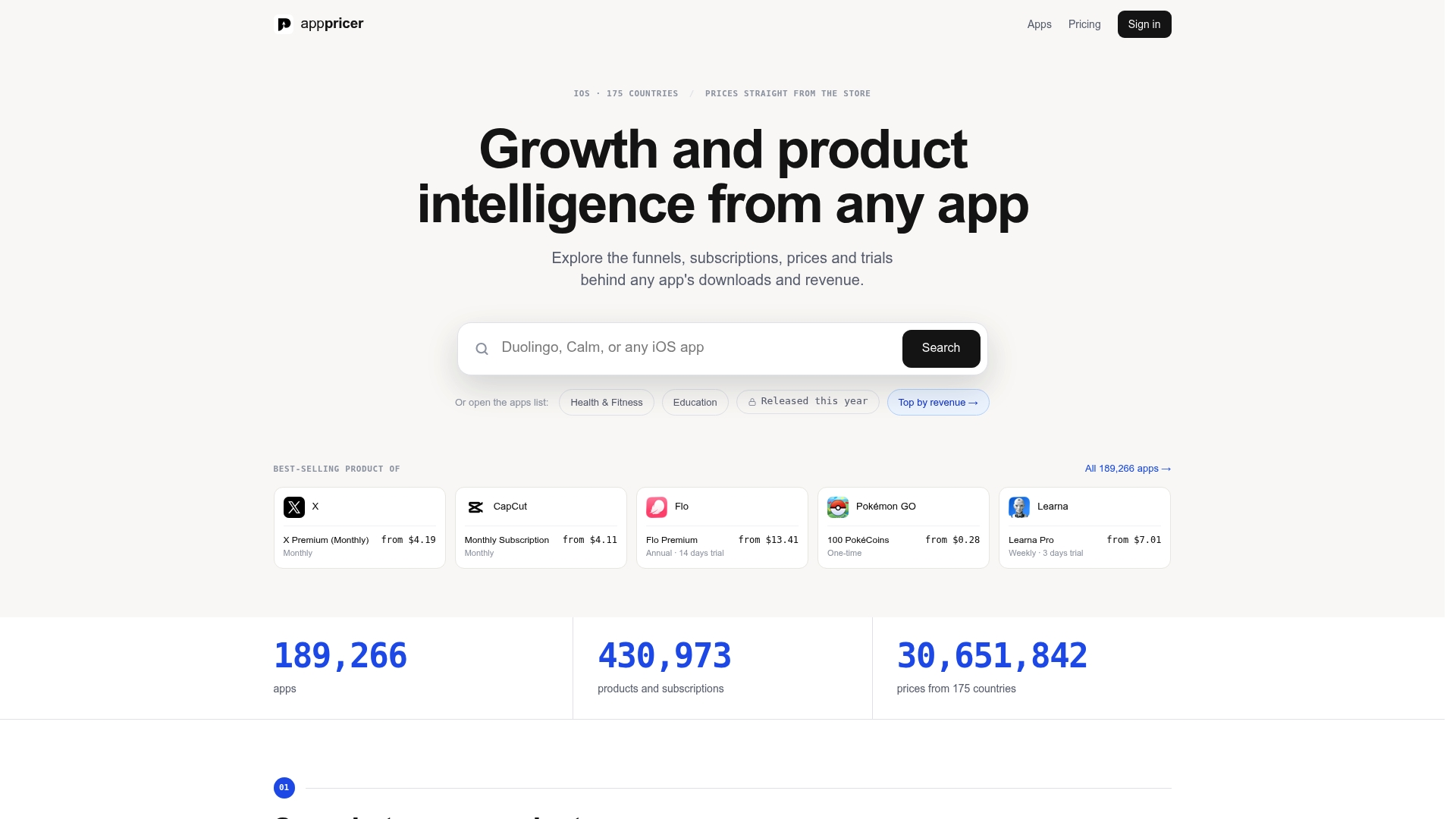
Run a competitive scan on the apps closest to your category before you finalize your next tier structure. Export price points for a specific target territory when you’re planning a regional rollout and need equalized pricing that accounts for local purchasing power. Generate a revenue projection scenario to see how a proposed price change might move your ARPU and MRR before you commit to it in production. Browse the full catalog of iOS app prices and subscription models to see how apps in your category are actually priced today, or head to Apppricer to start pulling competitor pricing signals for your own roadmap.
Three Things I’ve Learned Pricing Mobile Apps
Migrate engaged users to annual plans after they hit a clear engagement milestone, not on day one. It converts better once someone has felt the value.
Add a pause or step-down option before your cancel flow. It saves subscriptions that a flat cancel button would lose outright.
The biggest mistake I keep seeing is overcomplicating the tier structure. Three clear tiers with honest, upfront value communication will beat five confusing ones every time.
— Sergey
Sources
- Subscription Pricing: Which Model Is the Right One? | Stripe
- 5 Subscription Pricing Models, and How to Choose the Right One | NetSuite
- Subscription pricing models explained — Swell