90 Days to Profitable App Niches for Solo Builders Using Pricing Data

For solo builders, the most profitable app niches in 2026 are vertical health and fitness, finance helpers, and single-purpose AI utilities, because they combine repeated use or clear financial payoff with real pricing power. Exam prep and lifestyle verticals like pets and plants round out the shortlist. What ties them together is simple: daily habit, obvious money saved, or a deadline the buyer can’t ignore. Solo-built winners in these categories commonly reach moderate monthly revenue within their first year.
TL;DR:
- Focus on niche markets like postpartum health, expense splitting, or AI utilities, as they offer strong repeat usage and pricing power for solo developers.
- Use real competitor pricing and review data to validate demand before investing time in development, ensuring your idea is already tested in the market.
- Aim for monthly recurring revenue between $500 and $10,000 in the first year, with higher ARPU in health and finance apps, and seasonal spikes in exam prep.
- Prioritize narrow, functional MVPs and run pricing tests early to determine the optimal price point, avoiding overbuilding and feature bloat.
- Capitalize on demand gaps in less aggressive categories where demand exceeds current supply, especially in fast-moving health, remote work, and condition-specific mental health apps.
Table of Contents
- Top Profitable App Niches Ranked for Solo Developers
- Monetization Models That Actually Work for Solo Apps
- How to Validate Demand Before You Write a Line of Code
- What Revenue Actually Looks Like for Solo-Built Apps
- Using Pricing Data to Prioritize and Price Your Niche
- Your 90-Day Plan From Idea to Paying Users
- Reading the Competitive Landscape Inside a Niche
- Who Actually Buys in Profitable Niches
- Where the Next Wave of Profitable Niches Is Forming
- What Most Idea Lists Get Wrong
- Check Real Pricing Data Before You Build
- Sources
Top Profitable App Niches Ranked for Solo Developers
An analysis of more than 136,000 app store reviews and startup revenue data points ranks vertical health and fitness, finance helpers, single-purpose AI utilities, exam prep, and lifestyle verticals as the strongest categories for indie profitability heading into 2026, according to BigIdeasDB’s app idea research. Here’s how each one breaks down for a solo builder deciding where to spend the next three months.
1. Vertical health and fitness (postpartum, condition-specific coaching) Generic fitness apps are a graveyard. Narrow ones aren’t. A postpartum recovery app or a diabetes-specific meal tracker solves a problem broad platforms ignore, and users who feel understood stick around. That retention edge is why subscription pricing works here better than almost anywhere else. Statista’s digital health market outlook shows continued growth across digital health categories, which gives this niche real tailwind heading into 2026.
2. Finance helpers (invoice chasing, expense splitting, RSU and tax tools) People will pay for anything that saves them money or stops an awkward conversation. An app that automatically chases late invoices or splits a group dinner bill fairly has a built-in ROI story: “this app saved me $200” is an easy sell. Willingness to pay tends to run higher here than in almost any other consumer category.
3. Single-purpose AI utilities (headshot generators, short-form clip tools, resume rewriters) These apps do one thing, do it fast, and need almost no customer support. Photo AI, built by a solo founder, scaled to six figures in monthly recurring revenue within 18 months by staying narrow, according to the Indie Hackers case study on Photo AI. The catch: these tools get cloned fast. Defensibility comes from owning a workflow or a dataset, not from the underlying model, which anyone can rent from the same AI providers you use.
4. Education and exam prep (deadline-driven buyers) Nobody procrastinates on a licensing exam the way they procrastinate on a diet. That urgency creates seasonal revenue spikes and unusually high conversion rates right before test windows, making this one of the more forgiving niches for a first-time solo builder.
5. Lifestyle verticals (pets, plants) Pet owners and plant parents are famously loyal spenders, and they respond well to small, frequent purchases rather than one big subscription. Think plant identification credits or a $2.99 add on pack rather than a $15 monthly plan.
6. Local vertical tools and marketplaces Booking tools for niche service providers, local rental marketplaces, or scheduling apps for a single trade tend to monetize through commission or a flat subscription per location, and they face far less competition than anything aimed at a national audience.
Monetization Models That Actually Work for Solo Apps
Picking the right pricing model matters as much as picking the right niche. Here’s how to match them:
- Subscription fits health, fitness, and finance apps where the value compounds daily. Test price bands between $4.99 and $19.99 per month, or $39 to $99 per year for the committed tier.
- Freemium with usage credits fits AI utilities well. Let people try the tool free, then charge $0.99 to $9.99 for a pack of generations or exports.
- One-time purchase works for narrow lifestyle tools where users won’t come back often enough to justify a subscription.
- Commission-based pricing fits marketplaces and local booking tools, where you take a cut of a transaction instead of charging a flat fee.
- Hybrid models (free core plus a paid pro tier) tend to outperform pure freemium once the app has enough daily users to make upsells visible.
Forrester’s analysis of shifting subscription dynamics points to the same lesson: rigid, one-size pricing is losing to models that flex with how often people actually use the product, per Forrester’s commentary on evolving SaaS pricing. Habit, money saved, and deadlines all push ARPU higher, which is exactly why subscriptions survive in those categories and struggle everywhere else.
How to Validate Demand Before You Write a Line of Code
Skip this step and you’re gambling. Run it, and you’ll know within weeks whether an idea deserves your next three months.
- Mine reviews first. Read one and two-star reviews on the top three competing apps and log every repeated complaint or feature request. A cluster of similar complaints across dozens of reviews is a gap you can build into, as Interexy’s research on undiscovered app ideas points out.
- Build a landing page and run a small ad test. Spend $50 to $200 driving traffic to a one-page pitch. A click-through rate above 2% on a cold audience suggests real interest.
- Add a signup or a small paid pre-order. Ask for an email, or better, a $5 deposit. A conversion rate above 10% on visitors who reach that page is a strong green light. Below 3%, rework the pitch before building anything.
- Set a stop threshold up front. If you can’t hit meaningful email signups or a handful of pre-orders after two weeks of modest traffic, the idea needs a new angle or a new niche.
What Revenue Actually Looks Like for Solo-Built Apps
Set your expectations with real numbers, not survivorship-bias success stories. Solo-built apps in a focused niche commonly land between $500 and $10,000 in monthly recurring revenue during their first year, with a small top decile pushing past $25,000 MRR, according to CatDoes’ compiled data on solo app builders.
- Finance and health apps tend to post higher ARPU because the perceived value per user is higher; exam prep apps post lower baseline ARPU, but spike hard around test season.
- At 1,000 downloads, a well-tuned freemium app converting 3 to 5% of users to a $9.99 monthly plan generates roughly $300 to $500 in MRR before churn.
- A one-time purchase app at $4.99 with a 2% download-to-purchase rate nets around $100 from the same 1,000 downloads. Subscriptions almost always win the long game once retention holds past month three.
The App Store alone processed $1.3 trillion in developer billings and sales globally in 2024, which tells you the ceiling isn’t the problem. Getting your slice of it with a focused, well-priced niche app is.
Using Pricing Data to Prioritize and Price Your Niche
Before you build anything, pull three numbers for your target niche: the price tiers competitors charge, how many of them use subscriptions versus one-time fees, and the review quality of the top three apps. Low ratings paired with high download estimates on those top three apps is the single best signal of an open niche, a pattern that shows up clearly in BigIdeasDB’s large-scale review analysis.
- Score each idea on a simple scale: weak competition plus high willingness-to-pay beats strong competition plus low willingness-to-pay every time.
- Run the four-step worksheet: search the category, extract competitor pricing and ratings, score the opportunity, then test your own price point against theirs.
Pro Tip: Before you set your price, check what the top three apps in your niche actually charge for subscriptions versus one-time purchases. A tool like apppricer’s app catalog shows this pricing breakdown across markets, which saves you from guessing at a number that’s already been tested by someone else.
Your 90-Day Plan From Idea to Paying Users
Ship something narrow first. A single job done well beats five features done halfway, and it gets you to paying users faster.
- Weeks 1 to 4: Scope the MVP. One core flow, minimal onboarding, nothing extra. Target a working build within 4 to 12 weeks depending on complexity.
- Weeks 5 to 8: Test pricing. Run two pricing variants on your landing page, and compare a short free trial against a freemium tier with usage limits.
- Weeks 9 to 12: Track the metrics that matter. Watch activation rate, Day 1 and Day 7 retention, trial-to-paid conversion, and revenue per monthly active user.
Pro Tip: Retention data will tell you more in two weeks than a spreadsheet of feature ideas will tell you in two months. If Day 7 retention is under 10%, fix the core flow before you touch pricing again.
Reading the Competitive Landscape Inside a Niche
Competitive analysis for app niches works differently than it does for broader software markets. You’re not just counting competitors, you’re measuring how tired the incumbents look. Pull the top ten apps in your category and check three things: how recently each one shipped a meaningful update, how their star rating trends over the last six months, and how many of their reviews mention a feature that doesn’t exist yet.
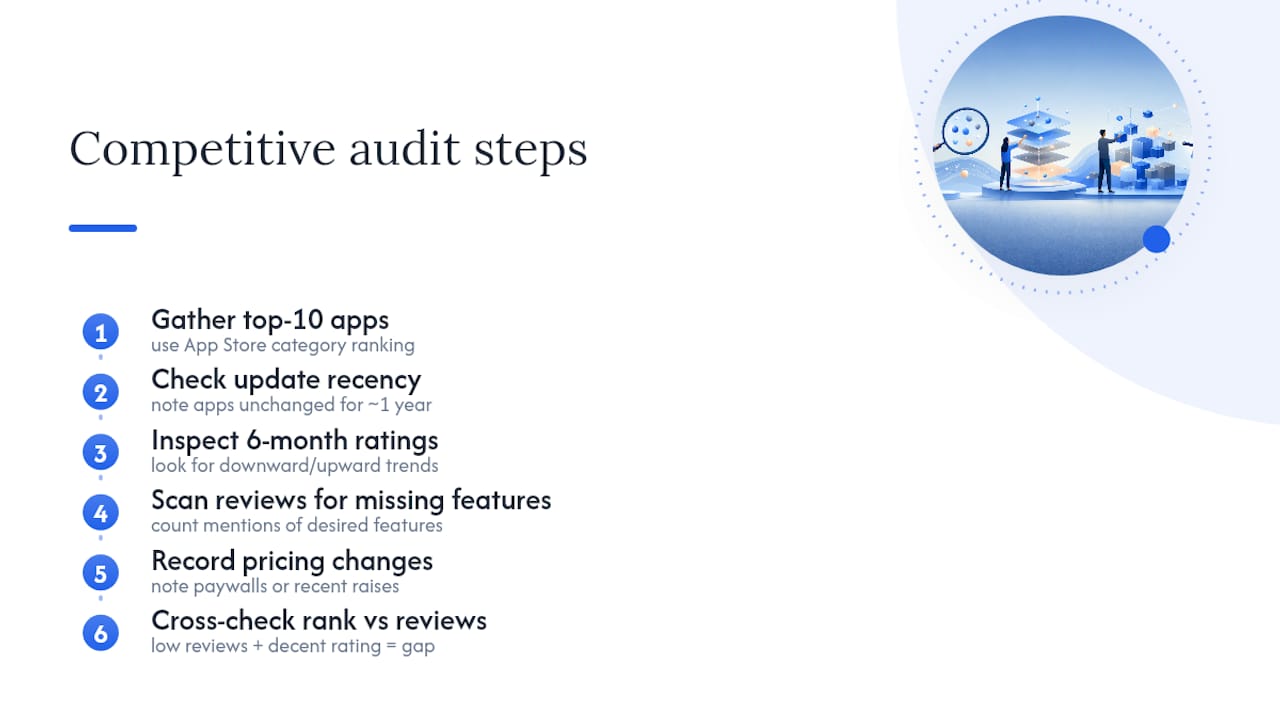
An app that hasn’t updated in a year but still ranks near the top is often coasting on brand recognition, not product quality, and that’s exactly the kind of competitor you can outmaneuver with something sharper and faster. Pay close attention to pricing changes too. A competitor that recently raised prices or added a paywall to a previously free feature is telling you something about their unit economics, and it’s telling you where a cheaper or more generous alternative might pull users away.
Cross-reference App Store category rankings against download estimate tools and review volume. A niche where the third and fourth-ranked apps have thin review counts but decent ratings usually means demand exists but supply hasn’t caught up. That gap is smaller and easier to fill than trying to unseat a category leader with tens of thousands of reviews and a five-year head start.
Who Actually Buys in Profitable Niches
Profitable app niches share a demographic pattern worth studying closely: the buyer is rarely the same as the broad “target market” a first-time founder imagines. Postpartum fitness apps sell to a narrow window of new parents in their first year, not “women who exercise.” Finance helper apps sell disproportionately to freelancers and small business owners juggling irregular income, not general budgeters.
Psychographics matter more than age or income bracket in most of these categories. The buyer for a finance helper app is someone who already feels anxious about missed payments or messy books. They’re not shopping for a nice-to-have; they’re shopping to make a specific pain stop. The buyer for an exam prep app is under deadline pressure and willing to pay a premium for anything that feels like it shortens the study grind.
Build a simple profile before you write any code: what does this person do the moment before they search for your app, and what does relief look like to them? A pet owner searching for a plant identification tool at 11pm because their dog just ate a houseplant has a completely different urgency than someone casually browsing plant care tips on a Sunday afternoon. Price and messaging should match that urgency level, not a generic user persona pulled from a template.
Where the Next Wave of Profitable Niches Is Forming
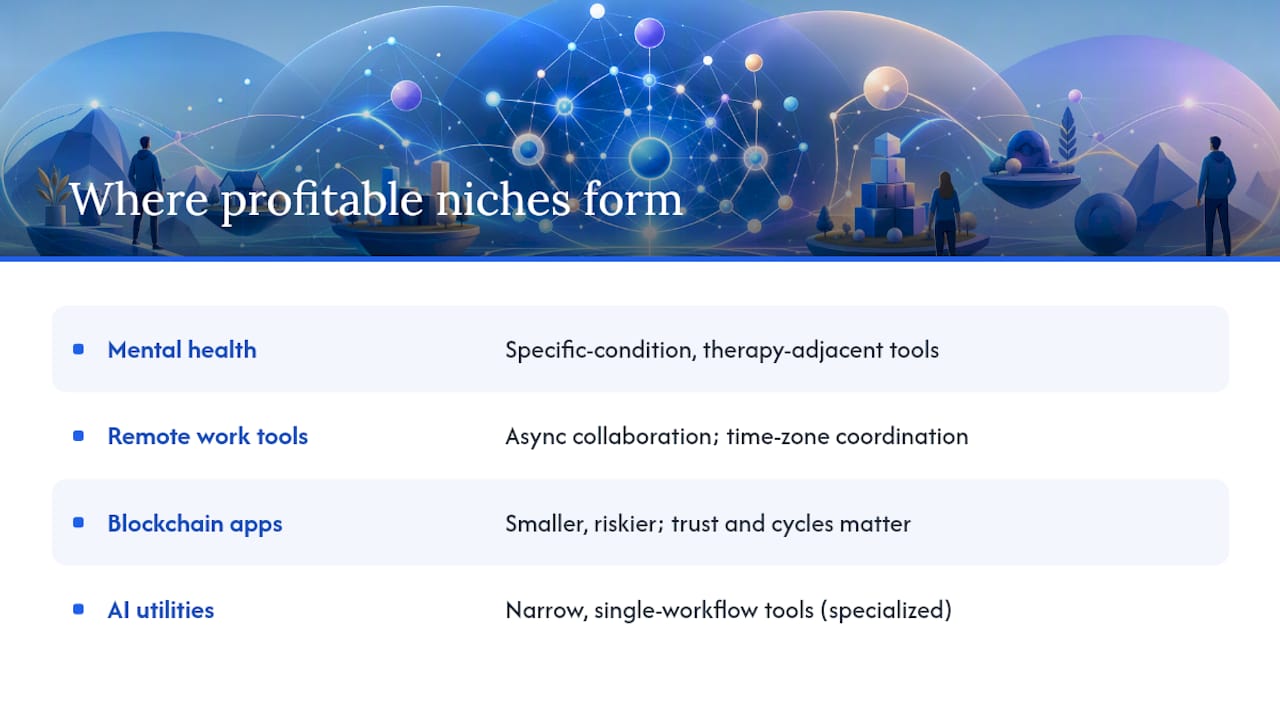
Mental health apps are moving from generic meditation timers toward specific, condition-focused tools, mirroring the same narrowing pattern that worked in fitness. Expect more apps built around specific diagnoses, therapy-adjacent journaling, or workplace burnout tracking rather than broad mindfulness.
Remote work tools are consolidating around async collaboration and time zone coordination as distributed teams stop treating remote work as temporary. The productivity tactics that make distributed teams effective, covered in Brainiac Media’s guide to fast-growth productivity habits, point toward the same conclusion: tools that reduce coordination friction, not just task lists, are where the next round of paid utility apps will emerge.
Blockchain-based apps remain a smaller, riskier bet for solo builders. The category swings hard with crypto market cycles, and building trust with users takes longer than in most other niches. It’s a category to watch, not necessarily one to lead with unless you already have deep domain expertise.
AI utilities will keep splitting into narrower and narrower slices. The generic “AI photo editor” wave has crested. What’s replacing it is AI tools scoped to one professional workflow, like a single-purpose contract redliner for freelancers or a niche AI tool for a specific creative trade.
What Most Idea Lists Get Wrong
Most builders overbuild the first version, ignore the complaints sitting in one-star reviews, and price by copying a competitor instead of testing their own number. The fix isn’t complicated: mine reviews weekly, run one pricing experiment per idea before writing more code, and resist the urge to add a second feature until the first one earns its keep. Small, narrow wins compound faster than big, unfinished ones.
— Sergey
Check Real Pricing Data Before You Build
A specialized analytics tool offers actual competitor pricing, subscription structures, and download trends across multiple countries, pulled directly from the App Store rather than guessed at. That matters because every validation step in this article, from checking price bands to spotting which subscription models dominate a niche, depends on real numbers instead of assumptions borrowed from a blog post.
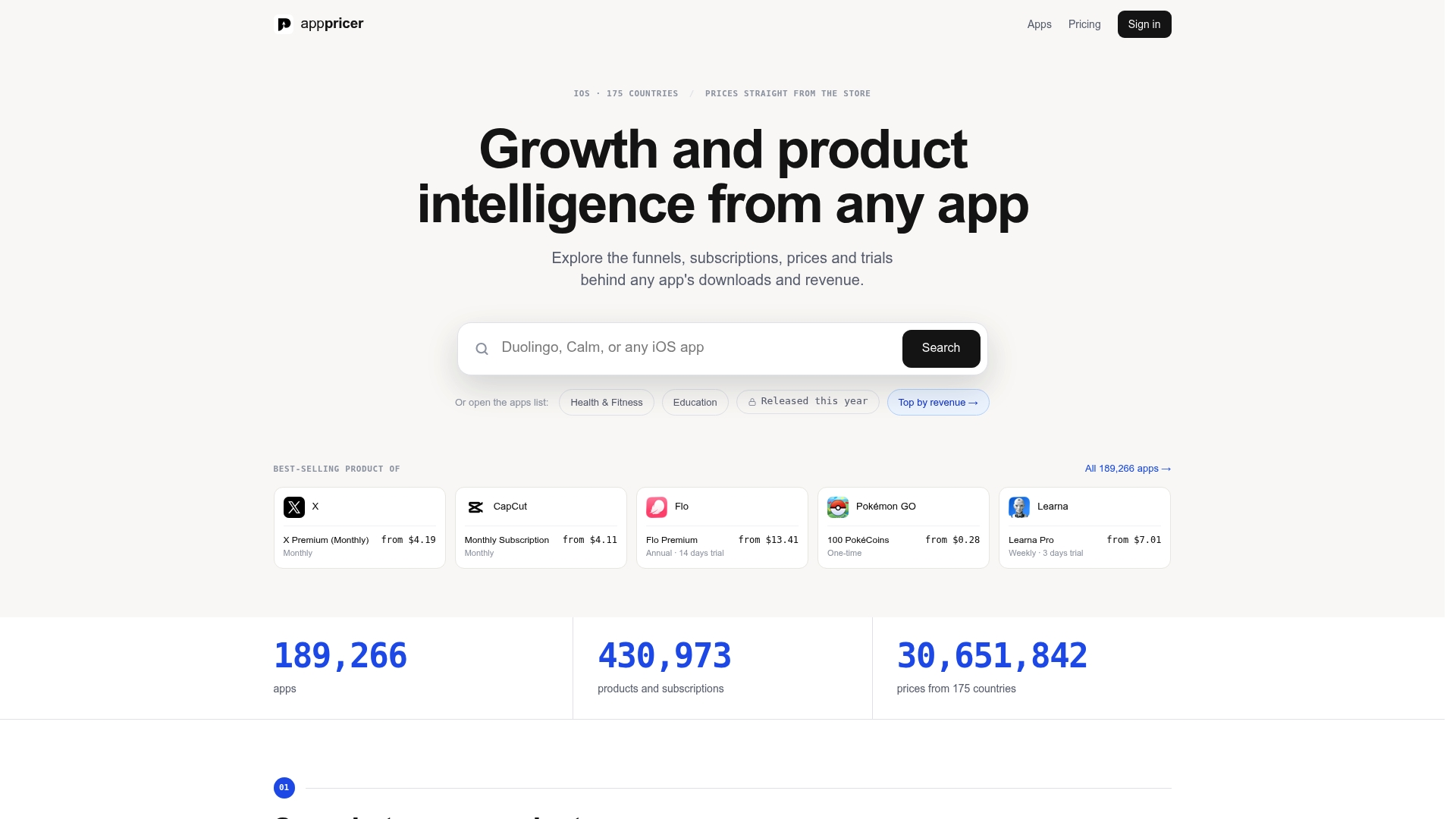
Instead of guessing what a competing finance app charges or whether a fitness app in your niche runs freemium or subscription-only, you can pull that data directly and price your own app against what’s actually working in the market. Browse the full catalog of iOS apps with live pricing and subscription data to check what the top three apps in your target niche are charging before you set your own price point, or visit the apppricer product page to see the full range of revenue and download tracking available across your niche.
Sources
- Digital health worldwide — Statista
- Photo AI case study — Indie Hackers
- 30 Most Profitable Mobile App Ideas for 2026 — BigIdeasDB
- SaaS as we know it is dead — Forrester blog