Price Increase Strategy for Pricing Managers: A Playbook

The right price increase strategy is value-first, segmented, and small: raise prices for your least price-sensitive customers first, tie every increase to a tangible improvement, and move in modest steps you can measure before scaling. That approach protects revenue while keeping churn low, and it works whether you’re running a subscription app or a retail SKU line.
Here’s what to do in the next 7 to 30 days:
- Pull your last two quarters of margin, churn, and cost data. If gross margin has dropped substantially, you likely have room and reason to act.
- Pick one low-risk segment (your least elastic cohort) for a pilot increase, not your whole base.
- Draft the customer notice now. Apple and most billing platforms require at least 30 days’ notice before a subscription price change takes effect.
- Set your three watch metrics before launch: 30 day churn, ARPU, and conversion rate on new signups.
Pro Tip: Open a short “buy at the old price” window before the change date. It typically pulls forward renewals and annual upgrades, giving you a real revenue bump before the new price even lands.
Key Takeaways
A price increase succeeds when it targets low-elasticity segments first, pairs the change with a concrete value improvement, and gets tested on a small cohort before a full rollout.
| Point | Details |
|---|---|
| Time the increase to signals | Move when margin compression is sustained, not after a single bad quarter. |
| Model before you set the number | Build a mini P&L to find your breakeven churn rate before picking a percentage. |
| Segment the rollout | Start with high-value, low-sensitivity customers; save light users for later waves. |
| Lead with value in messaging | Frame the increase around a feature or SLA improvement, never around your rising costs. |
| Benchmark against competitor data | Apppricer’s pricing and revenue data across 175 countries helps model an increase before you commit to a number. |
Table of Contents
- When Is the Right Time for a Price Increase Strategy?
- How Much Should You Raise Prices?
- Which Customers Should Get the Price Increase First?
- How Do You Communicate a Price Increase to Customers?
- How Should You Roll Out a Price Increase Operationally?
- What Metrics Show a Price Increase Is Working?
- What Pricing Psychology Reduces Pushback?
- What Are the Most Common Price Increase Mistakes?
- What Legal and Platform Rules Apply to Price Increases?
- What Do Pricing Managers Learn After Running Increases?
- How Analytics Reduce the Risk of a Price Increase
- Sources
When Is the Right Time for a Price Increase Strategy?
Three signals tell you it’s time: margin compression that’s sustained (not a one-off cost spike), a product that’s matured past its early-adopter discount phase, or capacity constraints where demand already outstrips supply. Any one of these alone can justify a move. All three together mean you’ve probably waited too long already.
Timing matters as much as the trigger. Align increases with natural cycles: contract renewal dates, the start of a new billing period, or right after you’ve shipped a feature customers actually asked for. Avoid raising prices during your seasonal demand trough or right before a competitor’s flagship launch.
Run this quick “now / wait / prepare” check:
- Now — margin has dropped notably for two straight quarters, or a supplier notice just landed on your desk.
- Wait — you’re mid-renewal cycle for a large share of accounts, or a major competitor just cut prices.
- Prepare — billing systems, CS scripts and legal review aren’t ready yet, even though the financial case is clear.
Retail and subscription businesses that time increases to demand and pair them with visible improvements consistently outperform those that spring a single large hike on customers with no warning, according to ASD Market Week’s analysis of retail pricing moves.
How Much Should You Raise Prices?
Before you pick a number, build a mini profit and loss model. You need four inputs: current price, gross margin percentage, variable cost per unit, and your estimated volume sensitivity (how many customers you expect to churn at a given price point). The outputs that matter are net sales value, gross profit, and your breakeven churn rate, meaning the maximum customer loss you can absorb before the increase actually costs you money.
That’s the cushion you’re solving for.
- Start with the smallest increase that meets your margin target.
- Test it on one segment before rolling wider.
- Recalculate breakeven churn using actual, not estimated, cancellation data after 30 days.
Pro Tip: *Stick to single-digit percentage moves unless you’re repositioning the product entirely (new tier, new packaging, new market).
Which Customers Should Get the Price Increase First?
Not every customer should feel a price change on the same day. Map your base on two axes: value to your business and price sensitivity. The sweet spot for a first move is high value, low sensitivity: customers who get significant use from your product and have few easy alternatives.
- Enterprise accounts on annual contracts with heavy feature usage are usually a safe first wave.
- Light users on month-to-month plans tend to be higher risk; save them for later, if at all.
- Customers locked into multi-year contracts might be contractually protected from mid-term changes, so check terms before you adjust pricing.
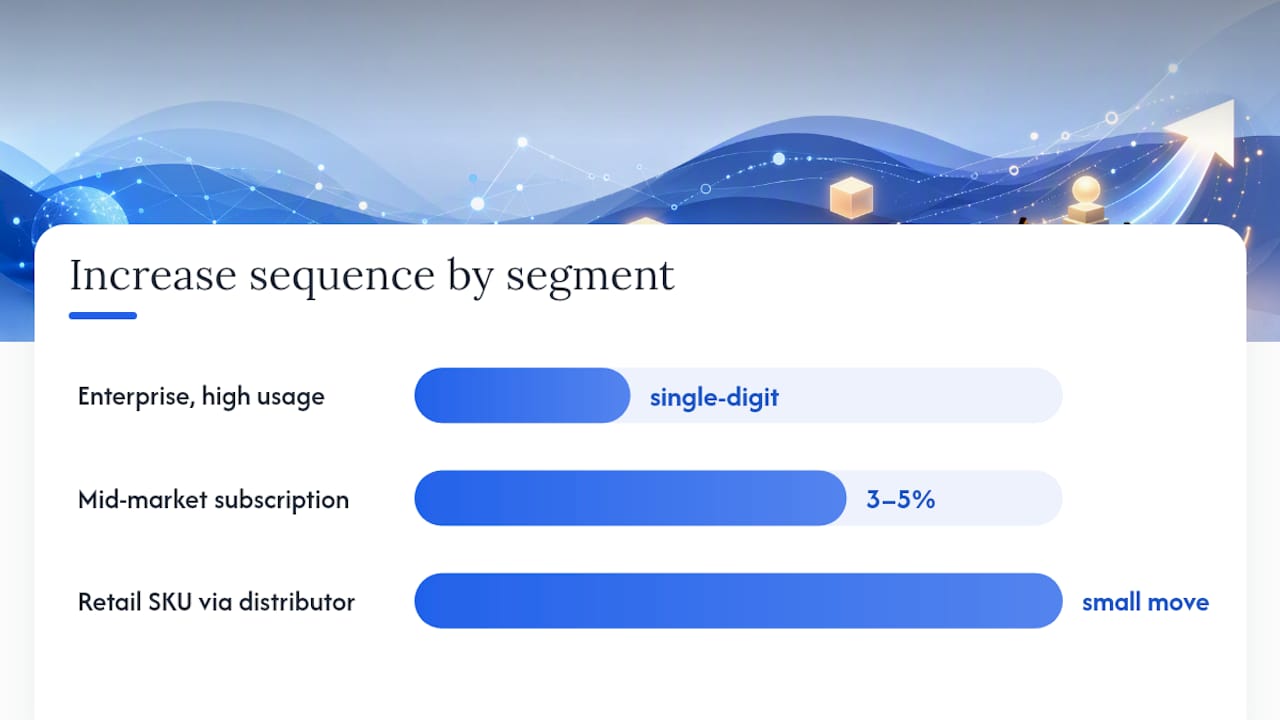
Three examples show how this plays out differently by business model. A high-frequency retail SKU sold through distributors needs a different lever entirely: small list-price moves paired with tighter control over distributor discounting, since heavy off-invoice allowances can quietly erode the increase before it reaches your books.
| Segment | Increase Size | Sequence |
|---|---|---|
| Enterprise, high usage | single-digit percentage move | First wave |
| Mid-market subscription | 3 to 5% | Second wave |
| Retail SKU via distributor | small list-price move | Third wave, with pocket-price monitoring |
How Do You Communicate a Price Increase to Customers?
The message matters more than the math. Harvard Business School’s Working Knowledge notes that clear messaging and phased rollouts reduce the churn spike that typically follows a poorly explained increase. The core rule: lead with what improved, not what it costs you to keep the lights on. Telling customers “we had to raise prices because of costs” reads as an internal problem, not a customer benefit, and savvy B2B buyers notice the difference.
Timing and cadence:
- Notify customers at least 30 to 45 days before the change date, longer for enterprise or annual contracts.
- Offer a short window where existing customers can renew or lock in at the old price.
- Send one reminder about a week before the new price takes effect, framed as a courtesy, not a warning.
Channel guidance depends on the relationship:
- Email remains the primary channel for subscription notices; keep the subject line direct rather than vague.
- In-product banners catch active users who skip email; use them for the final week before the change.
- Billing portal messaging should restate the new price and the reason in one short paragraph, not buried in fine print.
- Sales and support teams need a one-page script so every rep gives the same answer when a customer asks “why now?”
A workable email template: “Starting [date], [product] will move to [$X]/month. This reflects [specific improvement: new feature, expanded limits, better support response times]. If you renew before [date], you’ll keep your current rate.” That’s it. No apology, no hedging, no lengthy cost breakdown.
- Lead with the value story, not the cost story.
- Name the exact date and exact new price. Vague language creates more support tickets than the price itself.
- Give customers a clear action (renew now, switch tiers, or ask a question) rather than leaving them to guess.
- Never bury the increase in a larger email about unrelated product updates. Customers read that as evasive.
Pro Tip: Route every “why the increase” support ticket to a shared FAQ doc the team updates in real time. The first week after a price change generates a predictable pattern of questions, and a fast, consistent answer stops small frustration from turning into a churn decision.
How Should You Roll Out a Price Increase Operationally?
Phase the rollout instead of flipping a switch for your entire customer base.
- Pilot: one segment, two to four weeks, full metrics tracking.
- Cohort roll: expand to the rest of that segment plus one adjacent segment.
- Full roll: remaining segments, staged over 30 to 60 days to avoid support-team overload.
Grandfathering existing customers at their old rate for a fixed period, then packaging changes (bundling a feature that used to cost extra) softens the transition for legacy accounts who might otherwise churn on principle alone. Limited-time “lock your rate” offers reward loyalty without permanently capping revenue.
- Update billing systems and pricing tables before the first notice goes out, not after.
- Rewrite CS scripts so support reps aren’t improvising answers to pricing questions.
- Check sales compensation plans; a price increase that isn’t reflected in quota or commission structure creates internal resistance fast.
- Confirm invoicing and tax calculations reflect the new price everywhere, including any regional pricing tiers.
| Rollout Stage | Scope | Duration |
|---|---|---|
| Pilot | One segment | two to four weeks |
| Cohort roll | Segment plus adjacent group | 30 to 60 days |
| Full roll | Remaining segments | 30 to 60 days |
What Metrics Show a Price Increase Is Working?
Run the pilot as an actual test, not a soft launch. Define a control group that doesn’t see the new price yet, set a minimum sample size per cohort, and commit to a fixed observation window, typically 30 to 90 days, before drawing conclusions.
- Define cohorts by signup date, plan tier, and price exposure.
- Track a control group alongside the test group for the same period.
- Hold the test for at least one full billing cycle before making a rollback decision.
Watch these KPIs weekly, not just at the end:
- Churn at 30 and 90 days, compared against your pre-increase baseline.
- Average revenue per user (ARPU), which should rise even if subscriber count dips slightly.
- Conversion rate on new signups at the new price point.
- Retention cohort curves, to catch slow-motion churn that a 30-day snapshot misses.
Set decision triggers before you launch, not after the data comes in: if 30-day churn exceeds your breakeven threshold, pause the rollout and investigate the segment. If ARPU rises and churn stays within the modeled range, scale to the next cohort. Modest volume declines often still produce higher total profit, since variable costs stay largely flat while revenue per remaining customer climbs.
What Pricing Psychology Reduces Pushback?
Anchoring works because customers judge a new price against a reference point you control. Show the old price crossed out next to the new one, or introduce a higher-priced tier alongside your standard plan so the standard plan reads as the reasonable middle option. That’s decoy pricing, and it’s why so many subscription products have three tiers instead of one.

Framing beats justification every time.
Do: anchor to a specific feature or SLA improvement. Don’t: cite abstract inflation or vague “market conditions.” Customers can’t evaluate an excuse, but they can evaluate a new feature.
A software company raising its base plan by $5 saw far less pushback when it paired the increase with a doubled storage limit and faster support response times, compared to an earlier increase framed only as a cost adjustment.
Pro Tip: Charm pricing ($19 vs. $20) still works at the margin, but it can’t rescue a poorly justified increase. Use it to round out a value-based price, not as your entire persuasion strategy.
What Are the Most Common Price Increase Mistakes?
The biggest failure is treating every customer the same. A flat, one-size-fits-all increase ignores the fact that your most loyal, highest-usage customers will tolerate more than your price-shopping newcomers.
- Skipping a test entirely and rolling out to 100% of customers at once.
- Sending a weak, cost-focused message instead of a value-focused one.
- Ignoring distributor or channel leakage, where discounts quietly erase your list-price gain.
- Failing to monitor pocket-price realization in the first weeks, missing early signs of erosion.
- If churn spikes in one cohort, pause that segment immediately and review the messaging they received.
- If support tickets triple, deploy the FAQ fast and consider a short grace period for confused customers.
- If a distributor discounts around your increase, revisit the channel agreement before the next cycle.
What Legal and Platform Rules Apply to Price Increases?
If you sell subscriptions through Apple’s App Store, you’re required to give subscribers at least 30 days’ advance notice before a price increase takes effect, so they can cancel before being charged the new rate. Reviewing how competing apps structure their subscription pricing can help you benchmark your own notice period and tier design against what’s already working in your category.
Confirm these before any mass subscription change:
- Consumer notification timing meets platform and regional requirements, not just your internal timeline.
- Any promised refunds or price differences are calculated correctly in your billing system.
- Existing contract clauses don’t lock certain customers out of the change entirely.
Government audits of consumer price changes consistently find that unclear communication, more than the increase itself, drives complaints and “sticker shock.” Get billing and legal sign-off at least 30 days before any mass subscription price change goes live.
Common questions:
Do I need to notify customers by email specifically? Most platforms require notification through a method the subscriber will actually see, such as email or an in-app push, not just a terms-of-service update.
Can I apply different prices to new versus existing customers? Yes, in most markets, though the details depend on your platform’s terms and local consumer protection rules, so check both before finalizing tiers.
What Do Pricing Managers Learn After Running Increases?
Most price increase programs die from politics, not math. A pricing committee that meets monthly, tracks a backlog of prioritized opportunities by segment and channel, and reports results consistently will outlast whatever internal resistance shows up when sales pushes back on a specific account.
Two traps come up constantly. First, teams treat the first price test as the final answer instead of the first data point, and they either overreact to early churn or ignore early warning signs entirely. Second, nobody tracks pocket-price realization, so a “successful” list-price increase quietly gets discounted away by sales within a quarter.
How Analytics Reduce the Risk of a Price Increase
The biggest risk in any price increase isn’t the number itself. It’s the guesswork underneath it: what competitors charge, how their tiers are structured, and whether your planned increase even makes sense against the market you’re actually competing in. Apppricer tracks app pricing, subscription structures, and revenue trends across 175 countries, so you can model an increase against real competitor data instead of internal assumptions.
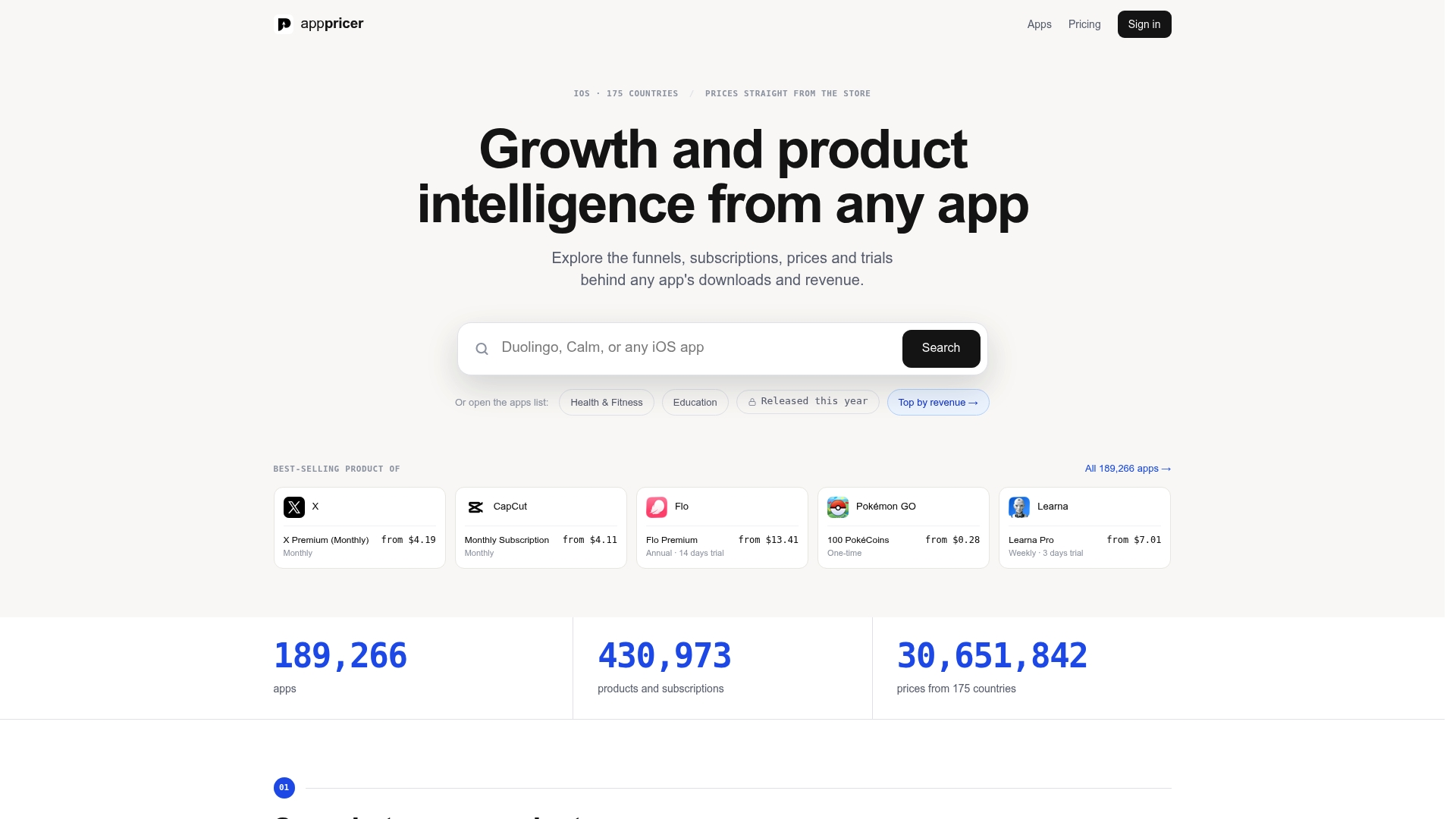
Three ways pricing teams use this before a rollout: running a diagnostic on where your current price sits relative to category leaders, analyzing how similar apps structured their own price increases and tier changes, and scanning competitor moves in real time so you’re not caught flat-footed by a rival’s repricing. If you’re planning a subscription price increase and want to see how comparable apps price their tiers, browse iOS app pricing and subscription data before you finalize your number.
Sources
- Managing price increases for auto‑renewable subscriptions — StoreKit
- Seven Tips for Managing Price Increases | Working Knowledge
- 1-Point Price Increase: A 6-Month Playbook | Valiotti Data
- A Smarter Approach to Retail Price Increases | ASD Market Week
- GAO report GAO-25-107451