Monthly vs Annual Pricing: Which Cadence Wins for SaaS?

Neither cadence wins outright. The right call is a hybrid, segment-first approach: monthly for trials and price-sensitive buyers, annual for stable core customers once the math justifies the discount. Run these three rules before your next pricing meeting:
- Start new or uncertain customers on monthly. Let them prove usage before you pitch annual.
- Offer the annual upgrade around 90 days of active use, once churn risk has settled down.
- Run the break-even calculation on any discount before you commit to it in a contract.
Pro Tip: Annual subscribers show meaningfully higher lifetime value and retention, while monthly plans consistently win on raw conversion volume. Optimizing for one number alone means sacrificing the other.
Key Takeaways
Segmenting customers by usage stability and running the break-even formula on every discount beats copying a competitor’s annual pricing outright.
| Point | Details |
|---|---|
| Default to monthly first | Start new customers on monthly and offer annual after roughly 90 days of active use. |
| Run the break-even formula | Use 12 × (1 − discount) to check whether a discount pays off before your typical churn point. |
| Stay inside benchmark ranges | Keep annual discounts between 10% and 30%, with 15% to 20% working for most subscription products. |
| Match cadence to segment | Push annual for enterprise and core tools; keep monthly for consumers and seasonal products. |
| Use real market data | Apppricer’s country-level pricing data helps validate discount sizing against actual competitor terms. |
Table of Contents
- Monthly vs Annual Pricing: The Pros and Cons at a Glance
- The Math Every Manager Must Run Before Choosing a Cadence
- Which Cadence Fits Which Customer and Product?
- How Do You Set the Right Discount and Test It Properly?
- Where Billing Operations Quietly Cost You Money
- What KPIs Actually Prove Your Cadence Strategy Is Working?
- What Apppricer’s Pricing Data Reveals About Discount Strategy
- Frequently Asked Questions
- Sources
Monthly vs Annual Pricing: The Pros and Cons at a Glance
Every pricing committee ends up drawing the same two columns. Here’s what actually belongs in them.
Monthly billing keeps the door open. The entry cost is low, so more people say yes at checkout, and conversion rates typically beat annual offers head to head. The tradeoff shows up later: churn is higher because canceling takes one click, and your payment processor works harder every 30 days, which means more failed cards, more retries, and more customer support tickets tied to billing.
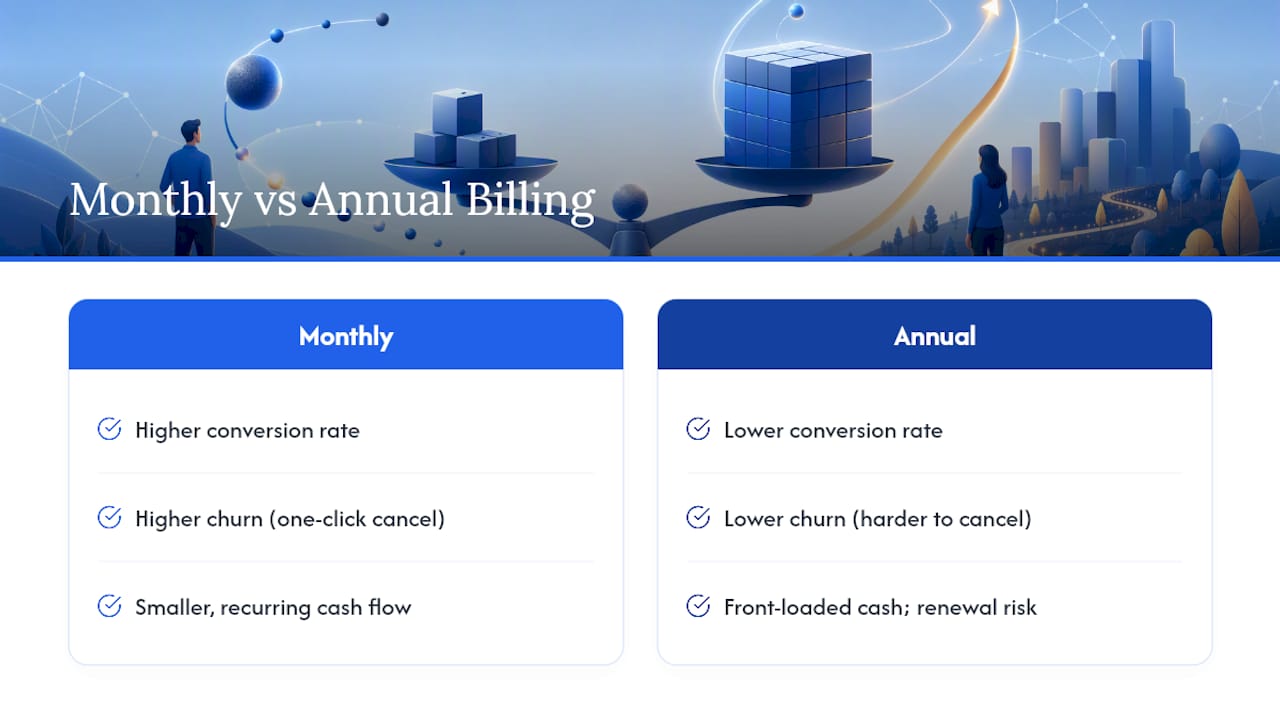
Annual billing front loads the cash. You get a year of revenue in one transaction, which helps runway and lowers the effective cost of acquiring that customer over time. Retention also tends to run higher simply because canceling requires more deliberate action. The risk moves to renewal day: a customer who quietly stopped using the product nine months ago is still an active subscriber right up until that one invoice lands, and now you’ve got a refund conversation instead of a quiet downgrade.
Discount psychology sits in the middle of this decision. A 10% discount reads as a rounding error to most buyers. A 30% discount reads as “this company needs my cash now,” which can spook procurement-savvy customers into wondering what’s wrong. The sweet spot most buyers respond to without over-discounting your own margin sits closer to the 15% to 20% range. This point, Recurly’s pricing analysis backs up with data across hundreds of subscription businesses.
The Math Every Manager Must Run Before Choosing a Cadence
Skip the gut-feel discount. There’s a formula, and it takes about thirty seconds to run.
- Calculate your break-even point. The formula is break-even months = 12 × (1 − discount). A 10% discount breaks even at 10.8 months. A 20% discount breaks even at 9.6 months. A 25% discount breaks even at exactly 9 months, according to the break-even math laid out by SubDupes.
- Compare that number to your actual monthly churn rate. If your typical monthly subscriber churns before month 9, a 25% annual discount is a bargain for you. If most of your monthly subscribers already stick around 14 or 15 months on their own, that same discount is giving away margin you didn’t need to give away.
- Check the payback effect on CAC. Annual prepayment collects a year of revenue upfront, which shortens your customer acquisition cost payback period dramatically compared to waiting on 12 separate monthly charges, a distinction Stripe’s guide to annual vs monthly billing walks through in detail.
There’s an accounting wrinkle that trips up teams moving to annual for the first time. You can’t book that lump sum as revenue the day it lands. Under standard revenue recognition rules, an annual payment gets recognized ratably across the 12 months of service delivered, not as a single spike. Your cash balance jumps immediately; your reported revenue doesn’t. CFOs who forget this distinction end up explaining a confusing quarter to the board.
A 20% annual discount doesn’t just need to “feel fair” to the customer. It needs to break even inside your actual churn window, or you’re subsidizing customers who would have stayed anyway.
Which Cadence Fits Which Customer and Product?
The right cadence depends less on your product category and more on how confident the customer is in their own usage.
- Consumer subscriptions: Lead with monthly. Consumers are price-sensitive and cancel-happy, so the low-friction entry point wins more signups even if it costs you some churn.
- Small and midsize business customers: Offer both, but nudge toward annual only after they’ve shown three months of consistent logins. SMB budgets shift quickly, and a customer forced into annual before they’re sure will just fight you for a refund later.
- Enterprise accounts: Annual or multi-year is standard here, and buyers often expect it. Procurement cycles favor a single annual invoice over monthly reconciliation, and seat counts at this tier tend to be stable enough to justify the commitment.
- Core daily-use tools: These earn annual commitment naturally because habit reduces churn risk on both sides.
- Experimental or seasonal tools: Keep these monthly, always. Forcing annual terms onto a tool a customer might only need for six weeks a year guarantees a bad renewal conversation.
Pro Tip: Quarterly and biennial terms are underused middle grounds. A quarterly plan captures the customer who’s not ready for a year but has outgrown month-to-month anxiety, a gap the Piano subscription research specifically flags as an opportunity most publishers and SaaS companies leave on the table.
How Do You Set the Right Discount and Test It Properly?
Don’t copy a competitor’s 20% because it looked reasonable on their pricing page. Their churn curve isn’t yours.
- Pull your own retention curve first. Find the month where a meaningful share of monthly subscribers naturally drop off. That number, not a competitor benchmark, is your starting point for the break-even calculation above.
- Anchor to the discount ranges that actually work. Most companies land between 10% and 30%, with the modal discount clustering close to 16.7%, roughly the “pay for 10 months, get 12” framing, per Recurly’s analysis. Going deeper than 30% rarely improves conversion enough to offset the margin loss.
- Present both options without forcing the choice. SaaS pricing commentary from SaaStr makes a blunt point here: hiding the monthly option to push annual conversion usually backfires by killing signups outright rather than converting hesitant buyers.
- Build the A/B test correctly. Test one variable at a time.
Run these checks before you trust the results:
- Test discount size (15% vs 20%) as one experiment, never bundled with a messaging change.
- Test presentation order (annual-first vs monthly-first on the pricing page) as a separate experiment.
- Require a sample size large enough to detect a difference in your actual conversion rate, not just directional movement over a few dozen signups.
- Read conversion-to-annual rate and 90-day retention together, never one without the other.
Where Billing Operations Quietly Cost You Money
Cadence choice isn’t just a pricing decision. It’s an operations decision that shows up in your dunning reports every month.
- Monthly dunning cycles need faster recovery sequences. A failed card on a monthly plan should trigger retry logic within days, since a lapsed monthly subscriber is easy to lose permanently.
- Annual renewals need advance warning, not a surprise invoice. Send renewal notices 30 and 7 days out at minimum. The “renewal cliff,” where a customer who stopped using the product months ago suddenly sees a full year’s charge, is the single biggest source of chargebacks and support escalations in annual billing.
- Build true-down and true-up language into enterprise contracts. Seat-based annual deals should specify how mid-term seat changes get reconciled, rather than leaving it to a conversation at renewal.
- Consider a price-hold clause for loyal annual customers. Locking in the renewal price for a second term reduces the shock that drives cancellations right when you most want the customer to stay.
What KPIs Actually Prove Your Cadence Strategy Is Working?
Track fewer metrics, but track the right ones on a fixed schedule.
- MRR and ARR, tracked separately so an annual prepayment spike doesn’t distort your monthly trend line.
- Churn rate, split by billing cadence, since blending monthly and annual churn hides which cohort is actually leaking.
- LTV and CAC, compared against each other every quarter, not just calculated once and filed away.
- Payback months, with anything under roughly 9 to 10 months generally favoring a push toward annual conversion, a threshold echoed in independent SaaS billing research.
- Conversion rate from monthly to annual, reviewed quarterly alongside whatever discount experiment is currently live.
What Apppricer’s Pricing Data Reveals About Discount Strategy
Guessing at a discount is optional once you can see what similar apps are actually charging. Apppricer aggregates real subscription pricing, term lengths, and revenue signals across 175 countries, which turns your discount decision from a hunch into a comparison.
- See how a subscription app in your category prices its annual plan relative to monthly in a specific country, rather than assuming your home-market pricing translates.
- Spot whether competitors in a given region lean toward a 15% discount or a 25% discount, and adjust your own test range accordingly instead of picking a number out of the air.
- Pull country-level price bands before expanding, since a discount that converts well in one market can look wrong in another.
Pro Tip: Feed Apppricer’s competitor price points directly into your A/B test as a benchmark variant, not your final number. Use it to sanity-check your own retention-based math, not to replace it.
A Pricing Manager’s Checklist
Before I sign off on any annual push, I run through the same short list. Give a new customer 90 days on monthly before offering annual. Run the break-even formula on the exact discount being proposed, then check it against actual payback months, not a target number pulled from a slide deck. Never apply a blanket annual campaign across every segment. Enterprise, SMB, and consumer customers behave too differently for one offer to fit all three. And negotiate renewal protections, like price-hold clauses, at the moment of signup, not after the first renewal fight.

Try Apppricer’s Pricing Intelligence for Your Next Decision
Running the break-even formula only gets you halfway there. You still need to know what a fair discount looks like in the market you’re competing in, and that’s where most pricing decisions turn into guesswork.
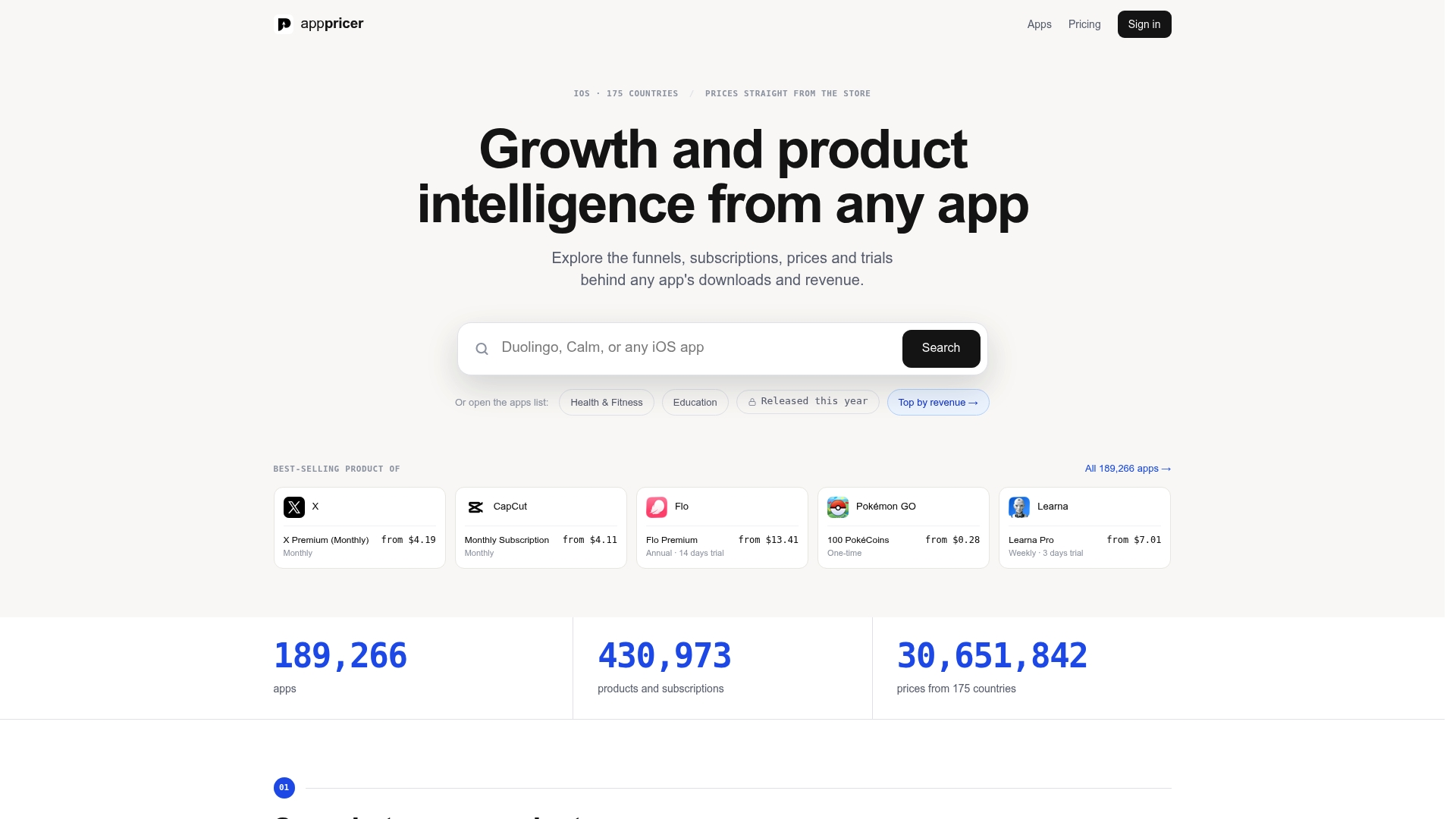
Apppricer removes that guesswork by showing you actual subscription prices, terms, and revenue patterns from real iOS apps and their subscriptions across 175 countries. If you’re deciding whether a 20% annual discount makes sense for a productivity app launching in a new market, you can pull up what comparable apps in that country actually charge before you set your own number, instead of applying a US benchmark globally and hoping it holds. Visit Apppricer to model your next pricing scenario against real market data before your next renewal cycle starts.
Frequently Asked Questions
Is monthly better than annual for a new SaaS product? Monthly usually wins early on because it lowers the barrier to that first signup, when you have the least retention data to justify an annual discount. Introduce annual once you can see which cohorts actually stick around past 90 days.
What’s a reasonable annual discount to offer? Most companies land between 10% and 30%, with the most common discount sitting near 16.7%, according to Recurly’s pricing research. Your exact number should come from your own break-even calculation, not that average.
Does annual billing always improve cash flow? It improves cash timing, not necessarily reported revenue, since standard accounting rules require you to recognize an annual payment ratably across the service period rather than all at once.
How long should a customer stay on monthly before I offer annual? Ninety days of consistent, active use is a reasonable checkpoint. It gives you enough signal that the customer isn’t a short-term trial user who’s likely to churn regardless of billing cadence.
Should I ever hide the monthly option to push annual conversion? No. Removing visible monthly options tends to suppress signups rather than force upgrades, a pattern SaaStr’s pricing commentary has observed across multiple SaaS companies.
Sources
- Annual vs monthly billing
- Monthly vs. Annual Subscriptions: A Pricing Analysis
- Monthly vs. annual subscriptions: why the answer isn’t either/or
- Annual vs Monthly Subscriptions: The Break-Even Math (and the Traps) Most People Miss