Under 2 Years? Lifetime vs Subscription Apps for Users and Makers

Lifetime pricing usually wins for users when the break-even point sits under two years and the app has no heavy hosting or API costs behind it. Subscriptions usually win for app makers, and often for users too, when the product needs ongoing servers, constant updates, or real support, as seen in subscription-based creative services that benefit from continuous content and design updates. The short version: buy lifetime for simple, static tools; subscribe to anything that runs in the cloud or evolves fast.
TL;DR:
- Lifetime purchases are most beneficial for simple, static tools used over a predictable period, typically under two years, with low ongoing costs.
- Subscription models favor apps requiring regular updates, cloud support, or AI-driven features, especially when costs could increase unexpectedly.
- The break-even point for lifetime deals generally falls between 1.5 and 2 years, depending on the app’s cost structure and user retention.
- Offering lifetime pricing as a default can harm a business’s future predictable revenue, support demands, and growth metrics if used excessively.
- Pricing and promoting lifetime deals should be carefully modeled with multi-year cost analysis and limited-time offers to avoid long-term business risks.
Table of Contents
- Lifetime vs Subscription Apps: How Each Pricing Model Actually Works
- Is a Lifetime Purchase Actually a Better Deal for Users?
- Should App Makers Offer Lifetime Pricing at All?
- How to Calculate Your Own Break-Even Point
- How to Price and Promote a Lifetime Offer Without Wrecking Your Roadmap
- The Due-Diligence Checklist Before You Launch a Lifetime Tier
- Should You Buy Lifetime, Subscribe, or Test an Offer?
- Why Subscription-First Beats Lifetime-First for Most App Businesses
- Run Your Own Pricing Experiment With Apppricer
- Sources
Lifetime vs Subscription Apps: How Each Pricing Model Actually Works
A lifetime purchase is a non-consumable, one-time transaction. You pay once, and Apple’s App Store treats it as owned forever, distinct from an auto-renewing subscription that bills weekly, monthly, or annually until canceled. That distinction sounds simple until you look at what each structure allows.
Subscriptions come with trial periods, subscription groups, and win-back offers built into the platform. Apple’s own subscription documentation spells out how proceeds rates and auto-renewal rules work, and one detail matters more than developers admit: Apple’s revenue share improves for the developer after a subscriber’s first year, rewarding retention over acquisition. Lifetime purchases get no such structural reward. There’s no proceeds bump for holding onto a customer, because there’s nothing left to renew.
Canceling a subscription is a tap. Getting a refund on a lifetime purchase, or migrating that purchase to a new device or account, often requires manual intervention from support. A few consequences follow from the “lifetime” label itself:
- “Lifetime” almost always means lifetime of the product or deal, not lifetime of the company.
- If the developer shuts down, sells the app, or discontinues the service, the lifetime promise ends with it.
- Refund windows for one-time purchases are typically short and rigid compared to subscription cancellation, which just stops future billing.
- Migrating a lifetime license across platforms (iOS to Android, or between accounts) is rarely automatic.
Hybrids exist too: some apps sell a “lifetime” tier that only covers core features, then subscribe users separately for cloud sync or premium add-ons.
Is a Lifetime Purchase Actually a Better Deal for Users?
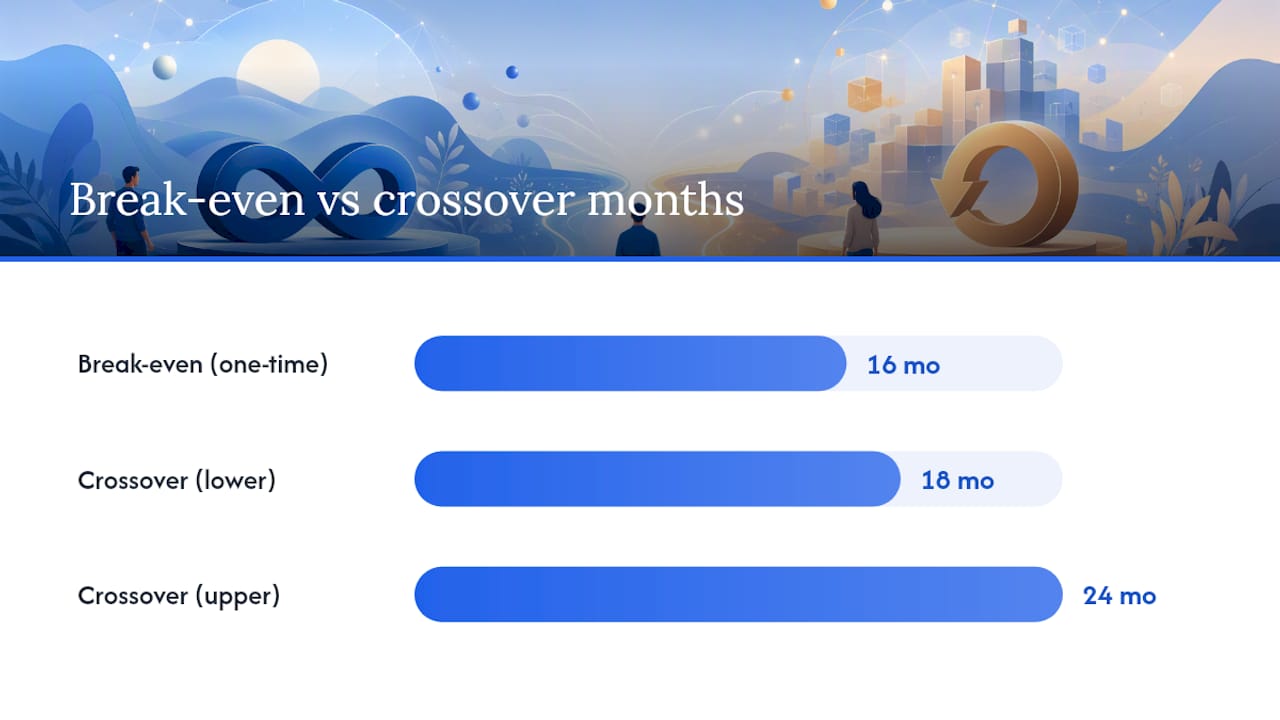
The math favors lifetime purchases more often than people expect, but not always by as much as the sticker price suggests. Start with break-even: divide the lifetime price by the monthly subscription price to get your payback period in months.
Say an app costs $80 lifetime or $5 a month. That’s 16 months to break even. Keep the app past that point and you’re saving money every month after. A multi-year comparison of software subscriptions against one-time licenses found the crossover typically lands somewhere between 1.5 and 2 years, though the “better” option wasn’t always obvious once extras got factored in.
Statistic to remember: Annual subscribers retain far longer than monthly ones, with 12-month retention around 33.9% for annual plans versus roughly 13.8% for monthly. That gap matters for a lifetime buyer too, because it hints at how long a developer expects a typical customer relationship to run, and therefore how they’ve priced the lifetime option against it.
Before you buy lifetime, consider these factors:
- Your expected usage period.
- Features exclusive to subscriptions, like cloud storage or updates.
- Refund policies and trial options.
- Data export capabilities.
- The likelihood of the vendor continuing support.
Should App Makers Offer Lifetime Pricing at All?
Lifetime deals inject cash immediately, but they trade away the thing investors actually value: recurring revenue. A breakdown of lifetime subscription strategy makes the trade-off explicit. Lifetime purchases often feel like a win to the customer, but they can quietly cannibalize the monthly and annual revenue that gives a business predictable valuation multiples.
The operational cost doesn’t end at the sale. Every lifetime customer still needs support, still expects bug fixes, and still uses server resources if your app touches the cloud. You’ve converted a recurring liability into a one-time credit, but the liability itself never goes away.
A few consequences product teams underestimate:
- Lifetime buyers rarely convert to paid add-ons later, since they already feel they’ve paid in full.
- Support tickets from lifetime customers don’t decline over time the way churned subscribers’ tickets do.
- A large lifetime cohort can distort your annual-recurring-revenue metrics when you’re raising money or reporting growth.
- Once sold, a lifetime deal is nearly impossible to walk back without damaging trust.
That said, lifetime pricing has real strategic uses. It can fund early runway before a subscription base matures. It can retain users who’d otherwise churn during a price increase. It can also work as a bundle add-on for a narrow niche feature that costs you almost nothing to maintain.
Pro Tip: Treat lifetime as a lever you pull occasionally, not a permanent fixture on your pricing page. The moment it becomes your default option, you’ve quietly turned your business into a one-time-purchase company, whether you meant to or not.
How to Calculate Your Own Break-Even Point
The formula is simple: break-even months equal the lifetime price divided by the monthly comparable price. Adjust that number for anything the subscription bundles that the lifetime tier doesn’t, like extra storage seats or premium integrations.
Two examples show how differently this plays out depending on what’s under the hood.
- Local desktop utility. A file converter with no server dependency sells lifetime for $60 against a $4 monthly plan. Break-even lands at 15 months. Since the developer’s ongoing cost per user is close to zero, lifetime is sustainable indefinitely, and the buyer wins if they keep using the tool past that mark.
- Cloud or AI-heavy app. A transcription app running API calls per session sells lifetime for $150 against a $12 monthly plan. Break-even looks like 12.5 months, tempting on paper. But if the underlying AI provider raises API costs, or usage per user climbs, the developer’s ongoing cost can exceed what they collected upfront. That’s the scenario where lifetime becomes unsustainable for the business, even when it look like a fair deal to the buyer.
| Scenario | Lifetime price | Monthly price | Break-even | Ongoing cost risk |
|---|---|---|---|---|
| Desktop utility, no hosting | $60 | $4 | 15 months | Low |
| Cloud/AI app, per-session API cost | $150 | $12 | 12.5 months | High |
The sensitivity that matters isn’t just the break-even number. It’s how that number moves if the developer raises subscription prices later, or if churn among monthly subscribers is high enough that the lifetime buyer’s price actually undercuts what the company collects from an average subscriber over their real tenure.
How to Price and Promote a Lifetime Offer Without Wrecking Your Roadmap
Pricing a lifetime tier at a multiple on your annual subscription price is common for mainstream offers, with premium or founder-tier deals sometimes reaching a higher multiple of the annual price. The BuiltByFoundry analysis of creator app pricing puts typical annual pricing at 5x to 7x the monthly rate to hit target lifetime-value goals, and lifetime offers usually sit as a multiple on top of that annual anchor, not the monthly one.
Where you place the offer matters as much as the multiple. Push it through email or push notifications as a limited-time event tied to a launch, a holiday, or a win-back campaign. Keep it off the permanent paywall unless you’ve deliberately decided lifetime is a core part of your business model, because a permanent lifetime option quietly trains price-sensitive users to wait for it instead of subscribing.
Watch these signals closely once an offer runs:
- Percentage of total revenue coming from lifetime sales. If it climbs past a small single-digit share, you’re leaning on it too hard.
- Refund rate on the lifetime tier compared to your subscription refund rate.
- Support ticket volume from lifetime buyers relative to subscribers, tracked over months, not just the launch week.
- Any dip in annual plan conversions during the window the lifetime offer runs.
Pro Tip: Run lifetime offers with a clear expiration date and stick to it publicly. A “limited-time” deal that reappears every quarter stops feeling limited, and price-sensitive users will simply learn to wait you out.
The Due-Diligence Checklist Before You Launch a Lifetime Tier
A structured risk checklist for lifetime deals recommends modeling a three-year total cost, not just the sale price, before committing to the offer. That means walking through:
- Hosting and API cost exposure per user over a multi-year horizon, not just at launch.
- Third-party API dependencies that could raise your per-user cost without warning.
- Data export and license transferability terms, spelled out clearly for buyers.
- Refund handling procedures, including how support will process manual requests.
- Projected support ticket load from a growing lifetime cohort that never churns out.
Pricing maps and retention benchmarks can help validate the break-even hypothesis before committing to a public lifetime offer, by allowing you to check what comparable apps in your category charge and how their subscription tiers are structured before setting your own multiple.
Pro Tip: Design your A/B test with a defined measurement window of at least 12 months, tracking conversion rate, refund incidence, support load, and the percentage of revenue the lifetime tier replaces from subscriptions, not just the initial signup spike.
Should You Buy Lifetime, Subscribe, or Test an Offer?
Run through these checkpoints before committing either way.
- Will you use the app for longer than the break-even period you calculated? If yes, lifetime likely wins.
- Does the app depend on cloud servers, API calls, or frequent content updates? If yes, subscription is the safer long-term bet.
- Do you need multi-device access or growing storage over time? If yes, subscription usually scales better.
- As a developer, is your ongoing per-user cost close to zero? If yes, a lifetime tier can be sustainable.
- Are you trying to fund short-term runway or fight a specific churn spike? If yes, a limited lifetime promo makes sense.
| Your situation | Recommended path |
|---|---|
| Static tool, long usage horizon, low hosting cost | Buy or offer lifetime |
| Cloud-dependent, evolving feature set | Choose subscription |
| Need short-term cash or churn fix | Run a time-boxed lifetime promo |
Why Subscription-First Beats Lifetime-First for Most App Businesses
Subscription-first pricing, with lifetime reserved for targeted promotions, protects the metric that actually determines what your app is worth: recurring revenue. A lifetime sale feels good the day it lands in your account. It feels a lot less good two years later when that same customer is still filing support tickets against a bill you already collected.
The mistake I see repeated across app categories is treating lifetime as a pricing tier instead of a pricing event. It should answer a specific question, whether that’s funding a launch, fighting churn during a price hike, or clearing inventory on a feature you’re sunsetting. Validate every one of those decisions against real pricing data before you commit, because category benchmarks on how competitors structure their annual, monthly, and lifetime tiers tell you more than intuition ever will.
— Sergey
Run Your Own Pricing Experiment With Apppricer
Deciding between lifetime and subscription pricing gets a lot less risky once you can see what similar apps in your category actually charge, and how those choices play out in retention. Some analytics platforms aggregate real pricing, subscription structures, and revenue trends across many countries, so you can check whether your planned lifetime multiple lines up with what’s already working in your niche instead of guessing at a number.
If you’re weighing a 5x annual lifetime offer against a straight subscription model, you can pull up comparable app pricing and subscription structures for your category first and see where the market has already settled. For developers who want a wider view, including revenue projections and download trends, the full Apppricer platform breaks that down by country and product. Run a sample report on a competitor in your niche before you finalize your next pricing test.
Sources
- A guide to lifetime subscriptions: are they right for your app? | RevenueCat
- I compared five years of software subscriptions with one-time purchases, and the better option wasn’t obvious | MakeUseOf
- Lifetime Deal vs Subscription Software: 9 Proven Checks to Avoid Risk | Toolrelief
- App Store subscriptions (Apple Developer)
- Annual vs monthly vs monthly subscription playbook | BuiltByFoundry