800 Price Points: 2026 IAP Pricing Strategy for Developers & PMs

The winning approach to IAP pricing treats every price point as a hypothesis, not a decision. Match consumables, non-consumables, and subscriptions to how users actually engage with your app, use starter packs and anchoring to convert first-time buyers, then measure lifetime value after Apple or Google’s cut, not before. Tools like the App Store price grid and market data platforms turn that process from guesswork into iteration.
TL;DR:
- Most free apps with in-app purchases generate nearly all of their revenue, making live price management and offer timing crucial for success.
- Combining multiple purchase types, such as consumables, non-consumables, and various subscriptions, helps reach diverse user intents and spreads revenue risk.
- App Store and Google Play commissions significantly affect net revenue at different price points, especially for subscriptions, requiring precise pricing strategies.
- Effective offer design, including timed starter packs and psychological anchoring, can outperform simple price adjustments in boosting conversions.
- Regularly testing and adjusting prices based on actual market benchmarks and full-funnel metrics prevents reliance on guesswork and optimize long-term revenue.
Table of Contents
- Why IAP Pricing Strategy Matters More in 2026
- IAP Types and How to Choose the Right One for Your App
- How Do App Store Price Grids and Commissions Actually Work?
- Offer Design Tactics That Actually Move Conversion
- What Metrics and Tests Actually Prove a Pricing Change Works?
- Should You Adjust Prices by Region or Stick to the Standard Grid?
- Common Pitfalls and Rules of Thumb Worth Following
- Using Market Benchmarks to Choose Your Starting Price Points
- Impact of IAP Pricing on User Acquisition and App Store Rankings
- Regulatory Considerations and Compliance for IAP Pricing
- Handling Refunds and Chargebacks Tied to IAP
- Balancing Revenue Ambition Against User Trust
- How Apppricer Helps You Run These Experiments
- Sources
Why IAP Pricing Strategy Matters More in 2026
Free apps with in-app purchases now dominate the economics of mobile software. Free-with-IAP models make up roughly 92% of monetizing apps and capture about 99% of total app revenue across large app catalogs. Upfront paid pricing barely registers anymore as a serious revenue engine.
That shift changes what “pricing” even means. You’re no longer setting one number at launch. You’re managing a live system of price points, offer timing, and renewal mechanics that Apple and Google both tax before you see a cent.
Here’s the number that should drive every decision: Apple takes 30% on most transactions, dropping to 15% on subscriptions after a subscriber’s first year, and as low as 15% flat for developers in its Small Business Program. Google Play adjusted its own subscription fee structure in 2026, moving toward lower flat rates in many cases. A $9.99 price point isn’t really $9.99 in your pocket. It’s whatever survives the commission structure your app qualifies for.
The strategic takeaway: pick your IAP model based on how often someone opens your app, not on what competitors charge. A daily-use habit app can lean on subscriptions because renewal frequency compounds. A one-time utility app should probably skip subscriptions entirely and sell a durable unlock instead.
IAP Types and How to Choose the Right One for Your App
Four purchase types cover almost every monetization scenario, and most successful apps don’t pick just one. Mixing purchase types to capture different user intents beats betting everything on a single model.
- Consumables: used once and gone (in-game currency, extra credits, boosts). Best for apps with recurring, discrete needs.
- Non-consumables: bought once, unlocked forever (pro features, ad removal, a filter pack). Best for apps where the value is a permanent capability, not ongoing content.
- Auto-renewable subscriptions: recurring access to content or a service (streaming, fitness plans, SaaS-style utilities). Best when your app delivers new value every week or month.
- Non-renewing subscriptions: fixed-term access that doesn’t auto-renew (a season pass, an event ticket). Best for time-boxed content tied to a calendar event.
A fitness app might sell a non-consumable to unlock all workout categories, then layer a subscription for live coaching. A puzzle game might sell consumable hint packs alongside a non-consumable “remove ads” unlock. The portfolio approach captures both the user who wants a quick fix and the user who wants ongoing value, and it spreads your revenue risk across purchase behaviors instead of leaning on one conversion event.
How Do App Store Price Grids and Commissions Actually Work?
App Store Connect lets you set a base country and let pricing auto-equalize across every other storefront, adjusting for local taxes and exchange rates. There are more than 800 available price points, and you can manually override any individual storefront if you have a reason to.
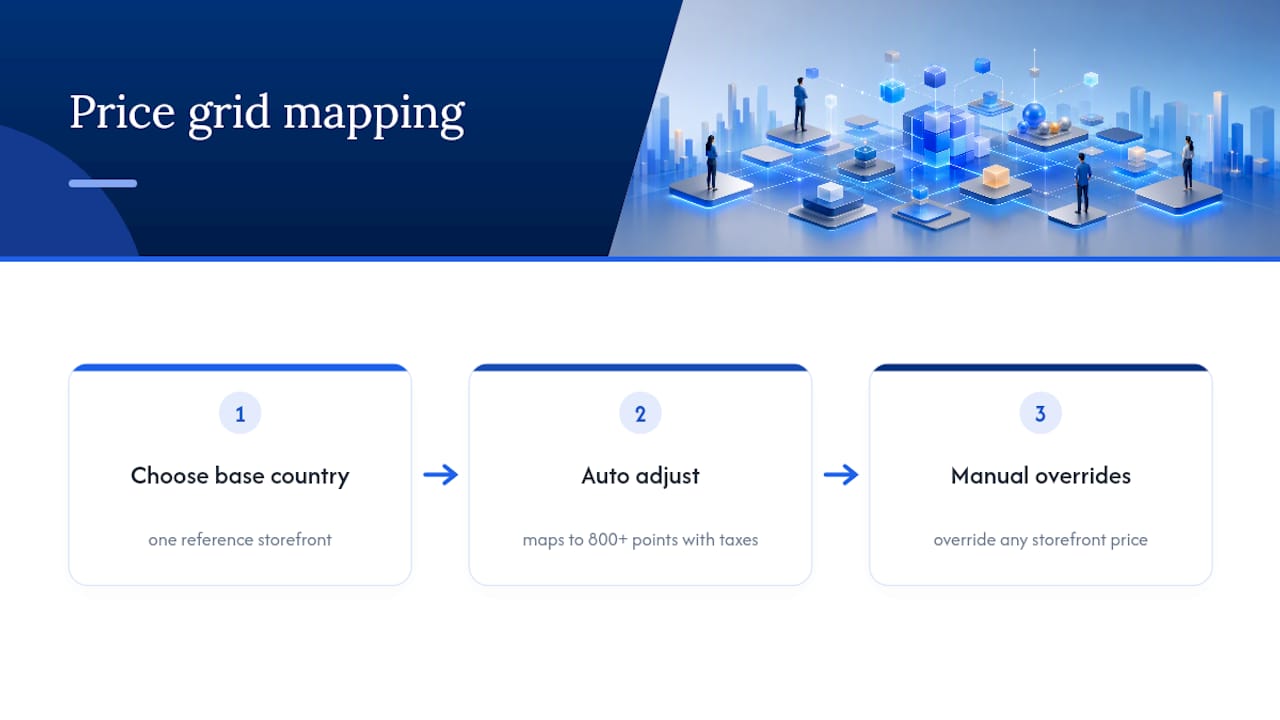
Subscription price changes come with their own rules. Apple requires different notice or consent flows depending on how big the increase is and how often the subscription renews, and you can only schedule one future price change per storefront per billing plan at a time.
Commission math is where a clean price point gets messy. Here’s what a $9.99 monthly subscription actually nets you under different scenarios:
That gap between $6.99 and $8.49 on the exact same price point is why so many developers underestimate long-term subscription economics. The first year looks worse than year two, which means your early churn numbers matter more than they appear to at a glance.
Offer Design Tactics That Actually Move Conversion
Price alone rarely decides whether someone buys. Unity’s own research on IAP conversion points to offer design, not raw price, as the bigger lever: starter packs, anchoring, and limited-time framing consistently outperform static pricing pages.
- Time your starter pack around the first meaningful “win.” Offer a discounted first-purchase bundle right after a user hits an early success moment, not on app open. Price it low enough to feel like an easy yes, usually well under your standard consumable price.
- Anchor with a decoy tier. Show three price tiers where the middle one is deliberately the best value. Buyers gravitate toward the middle option when a clearly worse deal sits next to it.
- Bundle slow-moving items with popular ones. Pairing a low-demand feature with a high-demand one lifts attach rate on both.
- Choose opt-out trials if paid conversion matters more than signup volume. Card-required trials convert at roughly 31% versus about 9% for opt-in trials, though opt-in pulls more total signups.
- Match trial length to habit formation speed. Seven days works for utility apps, 14 days suits habit and productivity apps, and up to 30 days makes sense for prosumer tools with a longer learning curve.
- Size your annual discount to actually move behavior. A 40 to 60% discount versus monthly pricing is usually the range that pulls users toward committing annually instead of staying month-to-month.
- Price lifetime unlocks at 24 to 36 times your monthly rate. That multiple reflects roughly two to three years of subscription value, which is enough to feel like a deal without giving away the store.
Pro Tip: Launch your annual plan and starter pack on day one, even before you’ve tuned pricing. You cannot A/B test a discount structure you haven’t shipped, and early cohorts give you the cleanest read on baseline conversion before feature creep muddies the data.
What Metrics and Tests Actually Prove a Pricing Change Works?
Four metrics matter more than any others: conversion rate (free to paying), ARPPU (average revenue per paying user), LTV (lifetime value, ideally cohort based), and payback period (how long until acquisition cost is recovered). Churn rate ties all four together, since a higher price that also raises churn can net out worse than a lower price with better retention.
Run pricing experiments like you would any product test:
- Write a specific hypothesis: “Raising the mid-tier price by 20% will reduce conversion by less than 10%, producing net ARPPU gain.”
- Segment by acquisition channel first. Comparing a paid-user cohort against an organic cohort will make an unrelated variable look like a pricing effect.
- Hold sample sizes long enough to see the full purchase cycle, not just day-one signups.
- Look at cohort-level LTV with at least a full renewal cycle of lookback for subscription products, since short-run signals often overstate or understate the real effect.
- Test paywall placement separately from price. An onboarding paywall shown before a user sees value behaves completely differently from a paywall triggered after a “delight” moment, like completing a first workout or finishing a project.
The paywall placement test is the one most teams skip, and it’s often worth more than a price change. Moving the same paywall from “immediately on open” to “after the third session” can lift conversion without touching a single price point. Reviewing conversion rate optimization techniques built for e-commerce funnels translates surprisingly well to paywall sequencing, since both are ultimately about timing an ask to match intent.
Should You Adjust Prices by Region or Stick to the Standard Grid?
Apple’s base-country system already equalizes pricing across storefronts for taxes and currency, which means the default grid is a reasonable starting point for nearly every app. Override it only once you have evidence, not intuition, that a specific market is underperforming.
- Start every new IAP on the base grid and let it run long enough to gather real conversion data by country.
- Override pricing downward in markets like India, Brazil, or Turkey when you see consistently low conversion tied to purchasing power, not app quality.
- Leave the US, EU, and Japan at standard tiers unless a specific test shows otherwise. These markets rarely need a discount to convert.
- Test one region at a time. Changing five markets simultaneously makes it impossible to know which change caused which result.
- Treat local pricing overrides as a targeted fix, not a blanket international discount strategy.
Common Pitfalls and Rules of Thumb Worth Following
A few heuristics save you from the mistakes that show up most often in real catalogs.
- Avoid pricing utility-app consumables under $3. Prices that low tend to signal low value and can actually suppress conversion rather than boost it.
- Ship an annual subscription option on day one, priced at a 40 to 60% discount against 12 months of monthly billing.
- Price lifetime unlocks at 24 to 36 times the monthly rate, and watch closely for cannibalization of your subscription tier once you launch it.
- Never treat pricing as a set-and-forget decision. Schedule a recurring review, quarterly at minimum, since most IAP prices cluster between $0.49 and $9.99 and that band shifts as categories mature.
- Don’t confuse a short-term revenue spike from a price hike with a sustainable outcome. Watch churn for at least one full renewal cycle before calling it a win.
Pro Tip: *If your lifetime price and your annual subscription price sit too close together, most buyers will take the lifetime option, and your recurring revenue base will quietly erode.
Using Market Benchmarks to Choose Your Starting Price Points
Guessing a launch price wastes the most valuable early data you’ll ever have. A faster approach starts with category benchmarks and narrows from there.
- Pull the median price and subscription structure for your app’s category from a market data platform like Apppricer’s catalog of iOS apps and pricing, which tracks pricing and subscription models across 175 countries.
- Set your initial price near the category median rather than guessing based on what one or two competitors charge.
- Launch a starter pack test against that base price before touching your core subscription tier.
- Watch ARPPU and 30 to 60 day LTV from that test, then adjust the base price up or down based on what the cohort actually does.
- Repeat the cycle quarterly as your category’s pricing benchmarks shift.
This workflow replaces “what does the top competitor charge” with “what does the whole category actually convert at,” which is a meaningfully different and more reliable question.
Impact of IAP Pricing on User Acquisition and App Store Rankings
Pricing doesn’t just affect revenue per user. It affects how many users you get in the first place and where your app ranks. Both Apple and Google factor engagement signals, install velocity, and revenue performance into ranking algorithms, so a pricing model that suppresses downloads can quietly hurt discoverability even if per-user revenue looks fine.

A price point set too aggressively high tends to depress the free-install funnel that most ranking algorithms reward, since fewer people convert from browsing to downloading when a paywall looms early. On the other hand, pricing too low can hurt your ability to fund paid user acquisition, since a weak ARPPU makes it harder to justify the cost per install that competitive categories demand.
The practical implication: think of pricing and acquisition as connected levers, not separate teams’ problems. A pricing change that boosts ARPPU by 15% but cuts your install-to-trial rate by 20% might look like a win on a revenue dashboard while quietly starving your acquisition funnel of volume. Track install volume and paywall conversion side by side whenever you test a price change, not just revenue per user in isolation. Ranking algorithms reward apps with strong overall engagement and revenue velocity, and a pricing decision that trades one for the other rarely nets out as a genuine improvement once you look at the full funnel.
Regulatory Considerations and Compliance for IAP Pricing
IAP pricing sits inside a regulatory environment that has gotten more complicated, not less. Consumer protection rules in numerous jurisdictions require clear disclosure of subscription terms, auto-renewal notices, and straightforward cancellation paths, and both Apple and Google enforce their own layer of requirements on top of local law.
Subscription price increases carry specific consent requirements. Apple requires explicit user consent for certain price increases above a defined threshold, while smaller increases may only require advance notice. Skipping the correct notice flow can get a subscription price change rejected or, worse, trigger forced refunds after the fact.
Regional consumer protection law varies enough that a single global policy rarely covers every market correctly. Some jurisdictions require a visible total cost before checkout, others mandate a minimum notice period before auto-renewal, and enforcement has increased in several regions over the past few years around “dark pattern” subscription flows specifically. Treat compliance as a per-market checklist rather than a global assumption, and build your price change and renewal notification flows around the strictest applicable jurisdiction rather than the most permissive one. That approach costs a little more upfront and saves you from a rejected update or a regulatory complaint later.
Handling Refunds and Chargebacks Tied to IAP
Refund requests are a normal part of IAP revenue, not an anomaly to eliminate. Apple and Google both operate their own refund systems, and developers generally have limited direct control over individual refund approval, since the platforms handle disputes to protect their own customer trust.
What you can control is the behavior that drives refund requests in the first place. Confusing subscription terms, unclear cancellation paths, and surprise renewals are the most common triggers for both refund requests and chargebacks. Clear upfront pricing, a visible trial-end reminder, and an easy in-app cancellation flow reduce both without costing you a cent in discounting.
Chargebacks carry a different weight than refunds because they can affect your standing with payment processors and, in some cases, your account health metrics on the platform itself. Track your chargeback rate as its own metric, separate from voluntary refunds, and treat a rising rate as a signal to review your billing clarity and renewal notifications before it becomes a bigger problem. Building a modest refund allowance into your pricing model, rather than treating every refund as pure lost revenue, keeps your financial projections realistic and keeps you from overreacting to normal churn.
Balancing Revenue Ambition Against User Trust
Chasing short-term revenue with aggressive price hikes or intrusive paywalls almost always costs more in churn than it earns in ARPPU. The apps that compound revenue over years are the ones that treat every pricing test as a trade against retention, not a standalone win. Run the experiment, but watch the churn number for a full cycle before declaring victory. Sustainable LTV beats a good quarter.
— Sergey
How Apppricer Helps You Run These Experiments
Every tactic in this guide depends on having real numbers to test against, not guesses about what competitors charge. Market data platforms provide aggregated pricing and subscription structures across multiple countries, giving you the category medians and price distributions you need to set a starting point before you run your first starter-pack test.
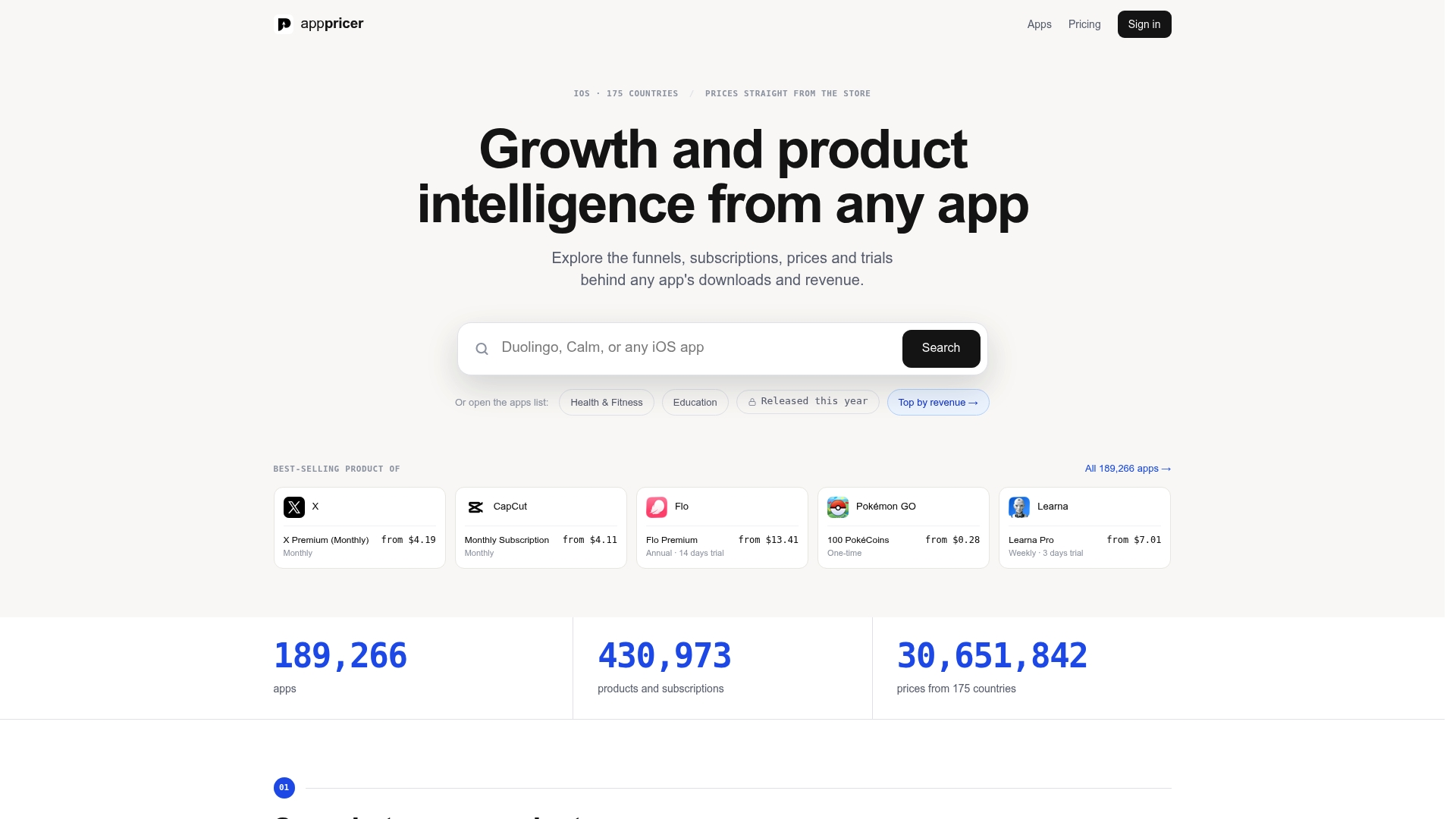
Say you’re launching a habit-tracking app and unsure whether to price your annual plan at $29.99 or $49.99. Instead of guessing, pull comparable app pricing and subscription data from Apppricer’s catalog to see what similar apps actually charge across major markets, then set your base price near that median before running the starter-pack and anchoring tests covered earlier in this guide. Track how your ARPPU and cohort LTV move against those benchmarks over the following weeks.
If you’re a growth manager trying to justify a price change to leadership, revenue projections and download trend data from Apppricer’s app intelligence platform give you the market context to back the request with numbers instead of intuition. Start by pulling your category’s pricing distribution and see how your current tiers actually compare.