Freemium vs Subscription: A Decision Framework for Product Teams

Choose freemium when you need maximum top-of-funnel reach and your cost to serve a free user is genuinely low. Choose subscription (usually delivered as a free trial, not an open-ended free tier) when your average contract value and time-to-value justify asking for payment upfront. Most companies that get this right eventually run a hybrid, because pure freemium and pure subscription each solve only half the problem.
The three inputs that actually decide this, not intuition or what a competitor does, are:
- Average contract value (ACV): low ACV products need volume, which favors freemium; higher ACV products can afford to ask for a credit card early.
- Time-to-value (TTV) and cost-to-serve: if a user needs 30 seconds to feel the product’s value, freemium works. If your infrastructure cost per free user is climbing toward real money, freemium stops being economical fast.
If you already know your ACV, TTV, and cost-to-serve, skip to the decision framework section below and run your own numbers through it. Everyone else, keep reading.
TL;DR:
- Freemium works best for low ACV, high-frequency products with short time-to-value, but becomes unprofitable if infrastructure costs or user engagement are high.
- Trials are more suitable for higher ACV, complex workflows, or products requiring longer onboarding, offering deeper conversion rates of up to 25 percent.
- Calculating cost-to-serve per free user and comparing it against expected revenue determines if freemium is sustainable or if a trial approach is necessary.
- Hybrid models combining freemium with timed feature trials often outperform pure strategies, especially when targeting diverse user segments.
- Regularly validating assumptions with actual competitor pricing and evaluating technical infrastructure is critical before scaling either model.
Table of Contents
- Freemium vs Subscription at a Glance
- What Actually Decides Between Freemium and Subscription?
- What Are Realistic Conversion Benchmarks and How Do You Model ARPU?
- Building Gates That Actually Convert Users
- Combining Freemium and Trials Instead of Choosing One
- How to Build Your Own Decision Score
- Rollout Checklist and the Mistakes That Break the Model
- How Apppricer Data Validates These Choices for Mobile Apps
- Where Freemium Wins and Where Subscription Wins
- How Should Market Segments Shape the Model You Pick?
- What Does the Competitive Landscape Tell You About Pricing?
- What Legal and Compliance Issues Affect These Models?
- Key Takeaways
- An Editorial Take on the Freemium vs Subscription Debate
- Sources
Freemium vs Subscription at a Glance
The two models optimize for opposite things. Freemium optimizes for reach and viral distribution. Subscription, typically wrapped around a free trial rather than a permanent free tier, optimizes for revenue predictability and a self-selected pool of intent-driven users. GeeksforGeeks frames this well: freemium maximizes reach and virality, while subscription buys you predictable recurring revenue and stickier customer relationships.
| Dimension | Freemium | Subscription (trial-led) |
|---|---|---|
| User entry point | Frictionless, no card required | Often requires signup intent, sometimes a card upfront |
| Revenue predictability | Low, depends on conversion at scale | High, recurring and forecastable |
| Typical conversion range | a low single-digit percentage free to paid | a higher single-digit to low double-digit percentage trial to paid |
| Churn pattern | High free-tier “churn” (never converts) | Lower churn once converted, but trial abandonment can be steep |
| CAC shape | Spread thin across huge non-paying base | Concentrated on qualified leads |
| Best-fit product type | Low ACV, viral, high usage frequency | Higher ACV, B2B, complex workflows |
Two things to flag before you build a model around this table. First, freemium’s operational cost scales with your total user base, not just paying customers, so a spike in signups can hurt your margins before it helps your revenue. Second, infrastructure risk is asymmetric: a subscription trial user who churns costs you almost nothing after the trial ends, but a free user can cost you money indefinitely if nobody ever caps their usage.
The benchmark gap between the two models is not subtle. DigitalApplied’s 2026 decision matrix puts good freemium conversion at 3 to 5% and best-in-class at 8 to 12%, while self-serve trials convert at 8 to 12% for a good result and 15 to 25% for a great one. Trials convert roughly two to three times deeper than freemium, which is exactly why so many companies that started as pure freemium eventually bolt a trial on top.
What Actually Decides Between Freemium and Subscription?
Forget “what does our competitor do.” Three variables drive this decision, and none of them are about taste.
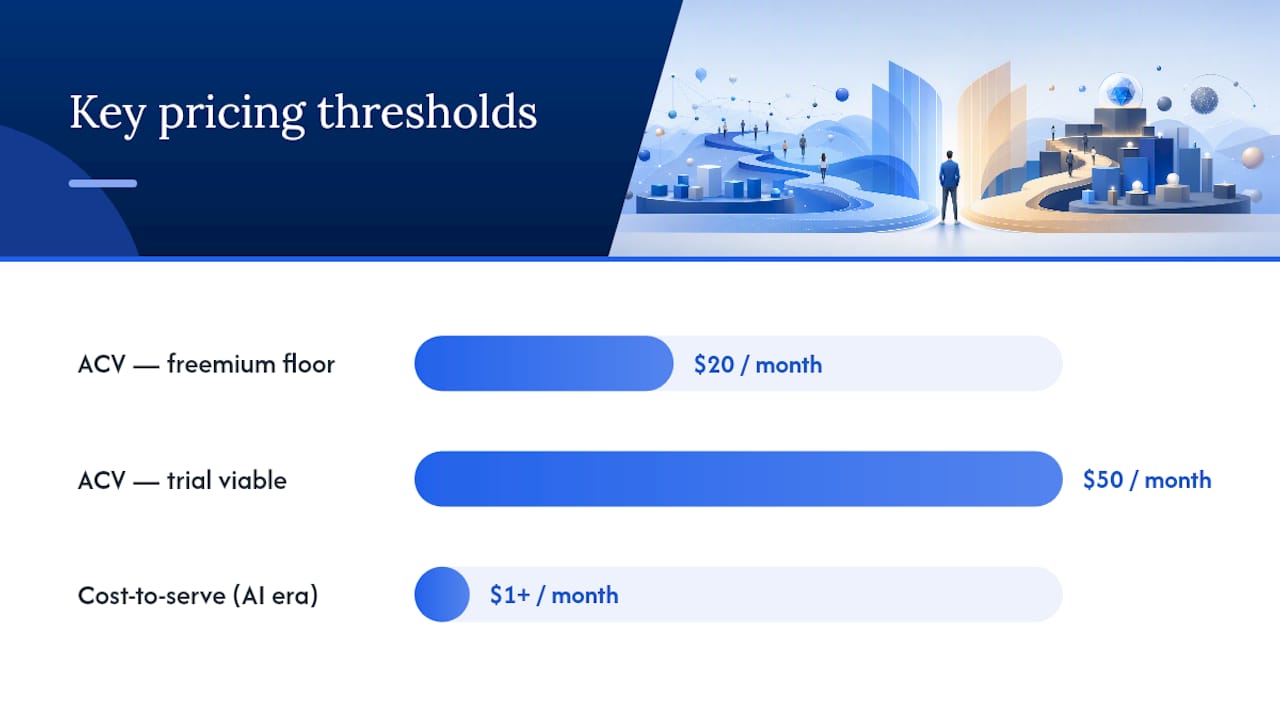
Average contract value (ACV) sets your tolerance for friction. If your product will realistically sell for around $10 to $20 a month, you cannot afford a sales-assisted trial process, and you need volume. Freemium (or a frictionless self-serve trial) is close to mandatory. Once ACV climbs past roughly $50 a month, or into four figures annually, the math flips: you can afford to lose some top-of-funnel volume in exchange for a smaller pool of higher-intent, higher-paying users. A $200/month B2B tool doesn’t need a million free users. It needs a few hundred qualified ones who convert at a respectable rate.
Time-to-value (TTV) determines whether freemium can work at all. TTV is how long it takes a new user to experience the “aha” moment that makes the product worth paying for. A photo filter app has a TTV measured in seconds. A project management tool for a 40-person team might need two weeks of onboarding before value becomes obvious. Freemium thrives on short TTV because users self-select into value almost immediately, and virality does the marketing for you. Long-TTV products lose users to abandonment long before they ever see the payoff, which is why B2B software with complicated setup almost always leans on trials, onboarding calls, or guided setup instead of an open-ended free tier.
Cost-to-serve is the variable most teams underestimate, and it has gotten worse. Stripe’s guidance on freemium pricing is blunt about this: freemium only works when the cost of serving a free user is low and the upgrade gates are designed well. That was true when “cost to serve” mostly meant database storage and support tickets. It is a much bigger problem now. AI-native products routinely push per-active-user inference costs toward $1 a month or more, and at that cost level, an uncapped free tier converting at typical freemium rates simply loses money on the free cohort, no matter how good your paid tier looks.
Here’s the inequality that should sit above every pricing meeting: if cost-to-serve per free user times your total free user count exceeds what your conversion rate delivers in paid revenue, your freemium tier is a subsidy program, not a funnel. Run this math before you launch a free tier, not six months after finance asks why gross margin is shrinking.
A rough field guide, directional rather than a formula:
- ACV under roughly $20/month, short TTV, low cost-to-serve: freemium is close to the default choice.
- ACV over roughly $50/month, or long TTV, or meaningful compute/support cost per user: lean toward a trial, gated or time-boxed.
- Anywhere in between, or when you’re not sure yet: build the hybrid described further down before committing to either extreme.
What Are Realistic Conversion Benchmarks and How Do You Model ARPU?
Numbers beat vibes here, and the SaaS industry has published enough of them to build a credible model. Freemium free-to-paid conversion generally runs in the low single digits for a solid product and somewhat higher for strong performers. Self-serve trials typically convert at mid to high single-digit percentages, with the best ones reaching low double digits, according to DigitalApplied’s decision matrix research. Opt-in trials, which do not require a credit card upfront, convert at moderately higher rates than freemium, while opt-out trials, requiring a card before the trial starts, tend to convert at even higher rates, reflecting more qualified users entering the funnel.
That gap between opt-in and opt-out trials is one of the most underused levers in pricing strategy. Requiring a card doesn’t just improve conversion, it changes who shows up in your funnel in the first place.
| Model | Typical conversion | Best-in-class conversion |
|---|---|---|
| Freemium (free to paid) | low single-digit percentage | moderate single-digit to low double-digit percentage |
| Opt-in trial (no card) | mid single-digit to low double-digit percentage | upper end of trial conversion rates |
| Opt-out trial (card required) | higher than opt-in trials | highest among trial types |
Here’s a worked example. If you’re running freemium at a solid 4% conversion rate, that’s 80 paying customers a month. At a subscription price of $15/month, that’s $1,200 in new monthly recurring revenue, before accounting for churn on the free side (which is nearly all of it) or the cost of hosting 1,920 non-paying users.
That’s 240 paying customers at the same $15/month, or $3,600 in new MRR, roughly three times the freemium outcome from an identical top-of-funnel number. The catch: you likely got fewer than 2,000 people into the trial funnel in the first place, because requiring signup intent (or a card) filters out casual visitors that freemium would have happily let in.
Payback period is the number that ties this together for anyone reporting to finance. If your blended customer acquisition cost is $40 and your monthly ARPU is $15, you need under three months to break even on that customer, which is healthy for a self-serve SaaS motion. Most efficient B2B SaaS companies target a payback period under 12 months; consumer-facing subscription apps often need it under three to five months given thinner margins and higher churn. If your model’s payback period stretches past a year at your current conversion assumptions, that’s a signal to either raise ACV, cut CAC, or reconsider the model entirely, not a signal to just run more traffic through the same broken funnel.
Building Gates That Actually Convert Users
The mechanics of the free tier matter as much as the decision to have one. There are three broad gating strategies, and most successful products combine at least two of them.
- Feature gating locks specific capabilities behind the paid tier while leaving core functionality free. This works when the gated feature is genuinely valuable but not essential to the core “aha” moment, think advanced reporting, integrations, or collaboration tools layered on top of a usable free product.
- Usage gating caps volume rather than capability, limiting things like number of projects, exports, or API calls per month. This scales naturally with how much value a user is extracting, which makes it feel fairer than an arbitrary feature wall.
- Seat gating charges per user rather than per account, which is the dominant pattern in B2B collaboration tools. A single user might use the product free forever; the moment a team needs to collaborate, seats become the upgrade trigger.
Instrument all three the same way: track the percentage of free users who hit the gate, and separately track what percentage of those who hit it actually convert within a week. A gate nobody hits is invisible and useless. A gate everyone hits immediately but nobody converts on is priced or positioned wrong, and you’ll want to test moving it further into the user’s workflow.
The upgrade moment itself deserves more design attention than most teams give it. The strongest in-product upgrade prompts appear right after a user experiences value, not before, and not as a generic banner. If someone just hit their project limit because they were actively building something, that’s the moment to show the upgrade prompt, not three days later in a marketing email. Stripe’s research on freemium design makes the same point: freemium only works long-term when upgrade triggers align with real usage milestones, not arbitrary time limits or feature walls disconnected from what the user is actually trying to do.
Pro Tip: Track “time to first gate hit” as its own metric, separate from conversion rate. If users take three months to hit a usage cap, your free tier is too generous and you’re subsidizing engaged non-payers far longer than you need to.
Combining Freemium and Trials Instead of Choosing One
The cleanest answer to “freemium vs subscription” for a lot of products is: both, sequenced correctly. ProductGrowth’s research on hybrid patterns identifies a pattern that captures the best of each side: a permanent freemium tier paired with time-limited feature trials layered on top.
Here’s how it works in practice. A user signs up for the free tier with no time pressure and no card required, which keeps your top-of-funnel wide open. At some point, usually triggered by an engagement milestone rather than a calendar date, you offer a 14-day trial of the premium tier, full access, no restrictions. If they don’t convert, they fall back to the free tier rather than losing access to the product entirely. This creates a high-intent upgrade moment without ever forcing an all-or-nothing decision.
The reverse trial is the inverse sequence: new users start with full premium access for a limited window, then get stepped down to the free tier if they don’t convert. This front-loads the “aha” moment for products with longer TTV, since users see the complete value proposition before any restrictions kick in.
A few operational details make or break hybrid execution:
- Billing systems need to handle proration cleanly when a trial user converts mid-cycle, not just at renewal.
- Messaging has to clearly distinguish “you’re on a trial” from “you’re on the free tier” so downgrades don’t feel like a bait-and-switch.
- Reverse trials work best for products with genuinely impressive premium features; if the premium tier isn’t visibly better, stepping users down just annoys them without generating urgency.
How to Build Your Own Decision Score
This is the part most freemium-versus-subscription debates skip: an actual spreadsheet you can fill in with your own numbers instead of a competitor’s case study.
Gather five inputs first:
- ACV — your average annual contract value, or monthly price times 12 if you don’t yet have real contract data.
- TTV — time-to-value in minutes for self-serve products, or days for anything requiring setup or onboarding.
- Cost-to-serve per active free user per month — hosting, support, and (for AI-native products) inference costs.
- Expected conversion rate — pull from the benchmark ranges above, freemium 3 to 12%, trial 8 to 25%, based on your product category.
- Addressable market size — rough number of realistic prospects, since freemium’s volume advantage only matters if there’s volume to capture.
Weight these based on what actually drives your unit economics.
Here’s a worked example for a hypothetical B2B analytics tool:
Run the weighted math: freemium scores roughly 3.8, trial scores roughly 7.75. For this product, a $40 ACV, three-day setup, and elevated per-user hosting cost, the trial model wins clearly, mostly because cost-to-serve and TTV both punish an open-ended free tier. This is a common pattern for mid-market B2B tools that look superficially freemium-friendly (low-ish price point) but actually carry too much onboarding and infrastructure cost to sustain a wide-open free tier.
If your own numbers come out closer together, within a point or two, that’s your signal to test the hybrid pattern from the previous section rather than forcing a binary choice.
Before committing to a full rollout of either model, run a smaller experiment first: launch the gate or trial to a segment of new signups only, measure conversion and cost-to-serve for 60 to 90 days, and only expand once the unit economics hold at that smaller scale. Committing company-wide before you’ve validated the gate placement is the single most expensive mistake in this decision.
Pro Tip: Rebuild this scorecard every time you ship a feature that meaningfully changes TTV or cost-to-serve. A product that started as a good freemium fit can drift into trial territory as it adds AI features or complex integrations, and most teams don’t notice until margins already show it.
Rollout Checklist and the Mistakes That Break the Model
Shipping either model requires more plumbing than most roadmaps budget for. Before launch, confirm you have:
- Gating logic that’s enforced server-side, not just hidden in the UI, since client-side gates get bypassed constantly.
- Billing infrastructure that handles upgrades, downgrades, and proration without manual intervention.
- Analytics events tracking gate hits, trial starts, and conversion moments, tied to a specific cohort so you can compare conversion by signup month.
- Dashboards splitting cost-to-serve by free versus paid users, updated at least monthly, since this number drifts as your product adds features.
- A defined kill criterion for the free tier, a cost-to-serve threshold or conversion floor that triggers a pricing review if crossed.
Once that’s live, the pitfalls that actually sink these programs are predictable and almost always avoidable. A free tier that’s too generous is the most common one: teams add “just one more feature” to the free plan to reduce signup friction, and two years later the free tier does 90% of what the paid tier does, gutting conversion. Hidden pricing is the second, tools that hide their price behind a “contact sales” wall when the ACV clearly supports self-serve checkout lose a meaningful share of would-be buyers who simply leave. Payment friction at the point of conversion, too many form fields, unclear billing cycles, no way to see total cost before committing, quietly kills conversion rates that looked fine in every earlier funnel stage. And in some markets, regulatory requirements around auto-renewal disclosure and cancellation rights add friction to subscription billing that a purely freemium model never has to deal with, which is worth flagging to legal before you finalize checkout flow, not after.
How Apppricer Data Validates These Choices for Mobile Apps
Every number in the frameworks above gets sharper when you can see what real competitors in your category are actually charging and how they structure it. That’s the specific gap Apppricer fills: aggregated pricing, subscription structure, and revenue data across 175 countries for iOS apps, pulled from actual live pricing rather than self-reported case studies.
Two ways product teams use this in practice:
- Spot-check price bands for comparable apps before finalizing your own ACV assumption. If you’re building a fitness app and assume a $9.99/month subscription is competitive, checking the actual pricing and subscription structures of similar apps across multiple markets tells you whether that number is aggressive, average, or leaving money on the table, and whether competitors are running freemium, trial, or a hybrid.
- Identify markets where freemium penetration runs high for your category, which changes your conversion assumptions regionally. A model that assumes 5% freemium conversion in one country might need adjustment in a market where competitor data shows heavier reliance on ad-supported free tiers instead of paid conversion.
The core value is replacing guesswork with observed market behavior. Instead of assuming your ACV, TTV, and expected conversion rate based on general SaaS benchmarks, you can check what apps solving a similar problem, in a similar category, in a similar region, are actually charging and how their subscription structure is built. That doesn’t remove the need for the decision framework above. It makes the numbers you plug into it far more defensible when you present them to a pricing committee or a finance partner.
Where Freemium Wins and Where Subscription Wins
Consumer apps with high usage frequency and low individual value per use, photo editors, casual games, note-taking tools, tend to be freemium’s best fit.
B2B tools with complex onboarding and genuine workflow lock-in, project management, CRM, analytics platforms, skew toward trial-led subscription. ACV is high enough to justify sales-assisted onboarding, and the product’s value only becomes obvious after real usage, which freemium’s low-commitment browsing doesn’t reward.
Finance apps sit in an interesting middle ground. Industry observation from Emacintl’s comparison of finance app monetization suggests paid finance apps often show meaningfully higher retention and lifetime value than freemium competitors in the same category, likely because financial trust and commitment correlate, and a paying user has already self-selected as serious about the outcome. Developer tools and infrastructure products, where cost-to-serve per free user can spike unpredictably (think API calls or compute-heavy tasks), increasingly favor usage-capped trials over open-ended freemium for the cost reasons discussed earlier.
How Should Market Segments Shape the Model You Pick?
Your customer personas determine which conversion benchmark actually applies to you, and treating all personas the same is a common way this analysis goes wrong. A prosumer buying for themselves behaves like a freemium user: price-sensitive, low patience for onboarding, quick to churn if value isn’t obvious in the first session. A mid-market team buyer behaves more like a trial user: they expect a guided evaluation period, they’re comparing you against two or three alternatives, and they want to see the product work with their own data before committing budget.

Segmenting your funnel by these personas, rather than assuming one model fits your entire user base, often reveals that you actually need different entry points for different segments. A single freemium tier that tries to serve both an individual hobbyist and a 50-person team’s IT buyer usually serves neither well; the hobbyist finds it too limited, the IT buyer finds it too under-featured to trust for a real evaluation. Enterprise segments almost never respond to freemium at all. They expect a sales conversation, a security review, and a proof-of-concept period defined by mutual agreement, not a self-serve trial clock. If your addressable market skews enterprise, the entire freemium-versus-subscription question is largely moot: you need a sales-assisted trial, full stop.
The practical move is mapping your known personas against the ACV and TTV variables from the decision framework separately, rather than running one blended number across your whole user base.
What Does the Competitive Landscape Tell You About Pricing?
Watching what competitors charge tells you less about what to charge and more about what buyers in your category have already been trained to expect. If every established player in your space runs freemium, buyers will resist a trial-only model from a newcomer, they’ve been conditioned to expect a free option before committing. Conversely, if your category is dominated by trial-led B2B tools with sales-assisted onboarding, launching a bare-bones freemium tier can signal “not enterprise-ready” to the exact buyers you want.
This is where a tool like Apppricer earns its keep in a pricing meeting: instead of guessing at competitor structure from marketing pages, you can pull actual subscription tiers and pricing across markets to see where the category consensus sits, and where a gap exists. A crowded freemium category with mediocre conversion rates across the board can be an opening for a trial-led entrant willing to break convention, provided your ACV and TTV support it. The competitive landscape sets buyer expectations, but it doesn’t dictate your unit economics, and those two things sometimes point in different directions.
What Legal and Compliance Issues Affect These Models?
Subscription billing carries more regulatory exposure than freemium in most markets, mainly because recurring charges trigger consumer protection rules that a one-time or free product doesn’t. Many jurisdictions require clear disclosure of auto-renewal terms before a user’s card is charged, along with an easy, visible cancellation path, sometimes with specific requirements about how many clicks or steps cancellation can take. Rules vary meaningfully by country and by whether the buyer is a consumer or a business, so a subscription flow built for one market’s requirements may not satisfy another’s without changes to disclosure language or cancellation mechanics.
Freemium carries its own, different compliance surface. Data collected from free users, especially when the free tier exists mainly to build a user base rather than generate direct revenue, still falls under the same privacy and data protection obligations as paid users in most regulatory frameworks. Treating free users as lower-priority for consent and data handling because they aren’t paying is a common but risky assumption.
Neither model is inherently simpler from a legal standpoint. Trial-to-paid conversions that require a card upfront need particularly clear disclosure about when the free period ends and billing begins, since this exact mechanic draws regulatory attention in several markets. Loop your legal team into the checkout flow design before launch, not after a support ticket flags a confused customer who didn’t realize their trial had converted to a paid subscription.
Key Takeaways
The right monetization model depends on matching ACV, time-to-value, and cost-to-serve to either freemium’s reach, subscription’s predictability, or a hybrid of both.
| Point | Details |
|---|---|
| Match model to ACV | Freemium fits low ACV, high-frequency products; trials fit ACV above roughly $50/month or complex B2B workflows. |
| Trials convert deeper | Trials typically convert 8 to 25% versus freemium’s 3 to 12%, per industry benchmark data. |
| Cost-to-serve caps freemium | AI-native products with rising per-user inference costs often can’t sustain an uncapped free tier profitably. |
| Test before full rollout | Run gating or trial changes on a segment for 60 to 90 days before committing company-wide. |
| Use market data to set assumptions | Checking real competitor pricing and subscription structures sharpens ACV and conversion assumptions before you finalize a model. |
An Editorial Take on the Freemium vs Subscription Debate
Most advice on this topic treats freemium and subscription as a philosophy question, a debate about growth versus revenue, when it’s really a math problem with three inputs. The evidence backs a boring but correct answer: run the ACV, TTV, and cost-to-serve numbers before you pick a camp. Teams that skip this and copy whatever their loudest competitor does tend to inherit that competitor’s mistakes along with their model.
The conventional wisdom that undersells itself hardest is the idea that freemium is “free” to run. It isn’t. Every free user carries a real cost, and that cost has grown as products lean on AI features with real compute overhead. If there’s one thing to prioritize before anything else in this decision, it’s building an honest cost-to-serve number for your free tier before you commit to it publicly. Everything else in the framework is easier to adjust after launch than a free tier you can’t afford to keep running.
— Sergey
Sources
- Freemium vs Free Trial: 2026 SaaS Decision Matrix Guide | DigitalApplied
- Freemium Pricing Strategy Explained | Stripe
- Freemium vs Subscription: Choosing the Best Monetization Path | GeeksforGeeks