Apple Commission Rates in 2026: What You Actually Pay

Most developers still pay somewhere between 15% and 30% on App Store sales, depending on enrollment status, subscription tenure, and where their users live. If you’re in the App Store Small Business Program, you pay a reduced commission. If you’re not enrolled and earned above the program’s eligibility threshold last year, you pay the standard higher commission. In the European Union, the math changed again on October 1, 2026, with new tiers running from 5% to 26%.
Three things to do this week, regardless of your app’s size:
- Enroll in the Small Business Program if your prior-year proceeds were below the eligibility threshold. It takes about 10 minutes in App Store Connect and can cut your commission significantly.
- Check your subscription-year status. Any subscriber past their 12-month mark should already be billing you at the reduced rate. Confirm it’s actually being applied.
- Run a quick feasibility check on external payments or web checkout. Not every app can benefit, but a growing number can, especially in the EU and, for now, in the US.
Pro Tip: Regional rules move fast right now. What’s accurate for your app in the US this month could shift depending on ongoing litigation, so treat any external-payment strategy as a temporary window, not a permanent architecture decision.
Key Takeaways
Your effective Apple commission depends less on a single headline rate and more on whether you’ve enrolled in the right program and structured your subscriptions to capture the automatic 12-month discount.
| Point | Details |
|---|---|
| Enroll in Small Business Program | Cuts commission from 30% to 15% for developers under $1M in prior-year proceeds; takes about 10 minutes. |
| Check subscription-year status | Subscribers past 12 months automatically drop to 15% regardless of enrollment; confirm it’s applied. |
| Know your EU tier | EU rates now range from 5% (alternative marketplaces) to 26% (Apple’s own payment system), effective October 1, 2026. |
| Treat US link-outs as provisional | External payment links remain legally contested pending Supreme Court review; plan for possible change. |
| Model before rebuilding | Use tools like Apppricer to compare country-level pricing and subscription data before committing to a web-first re-architecture. |
Table of Contents
- Official Apple Commission Rates: A Clear, Sourced Breakdown
- Regional Differences and the 2026 EU Overhaul
- Tactics to Lower Your Effective Commission
- How Apple Calculates Eligibility and Proceeds
- Choosing Your Path: Stay, Add Options, or Rebuild
- Apppricer Modeling: Three Scenarios and the Payback Math
- What Small Teams Should Prioritize First
- Model Your Own Commission Scenarios Before You Commit Engineering Time
- Frequently Asked Questions
- Sources
Official Apple Commission Rates: A Clear, Sourced Breakdown
Apple’s fee structure is not one number. It’s a set of tiers that depend on where the transaction happens, what payment rail processes it, and whether you’re enrolled in a qualifying program.
Here’s how the tiers break down for apps distributed through Apple’s own storefront outside the EU:
| Transaction Type | Standard Rate | Reduced Rate (if eligible) |
|---|---|---|
| App Store in-app purchase | 30% | 15% (Small Business Program) |
| Subscription, year one | 30% | 15% (Small Business Program) |
| Subscription, after 12 months | 15% | No further reduction |
| Video Partner Program content | Negotiated, typically lower | Varies by agreement |
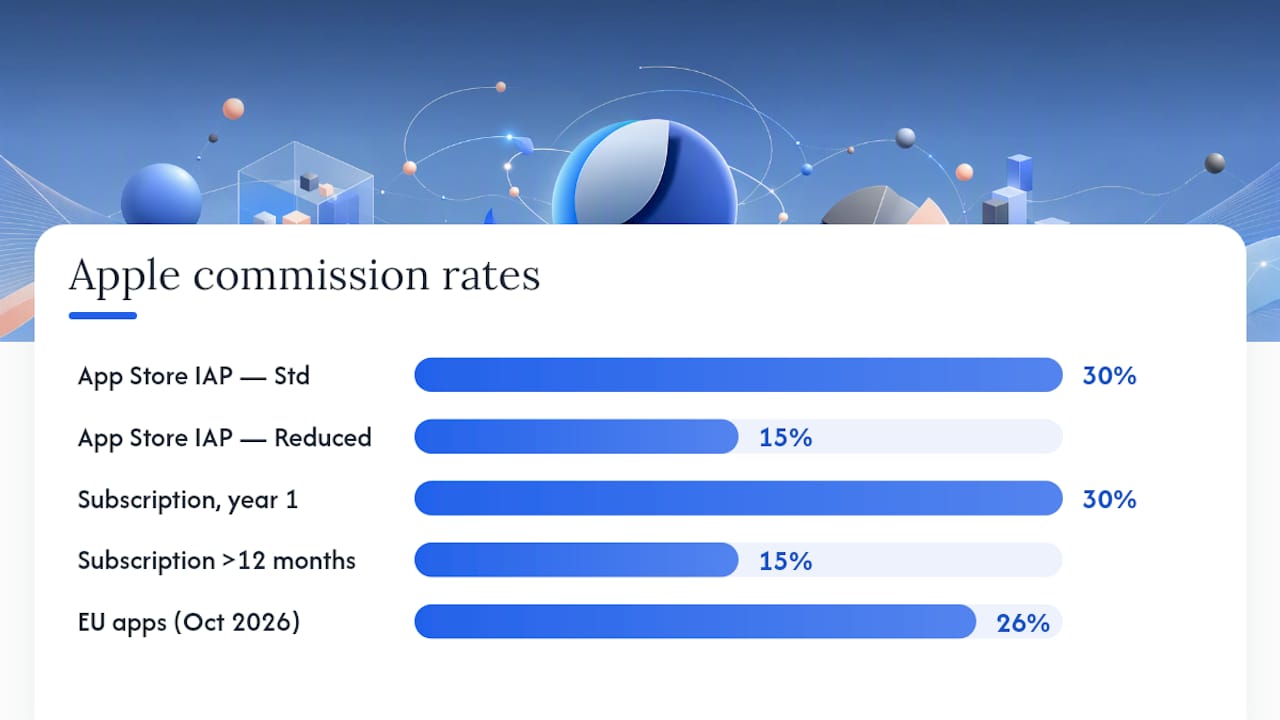
The 15% reduced rate shows up in two separate ways, and developers often confuse them. One is the Small Business Program, which drops your entire commission to 15% if your total proceeds across all your developer accounts stayed under $1 million the previous year. The other is the automatic subscription discount: once a subscriber has been paying for more than a year, Apple cuts its cut from 30% to 15% on that subscriber’s payments, no enrollment required. A large developer with no Small Business eligibility can still get 15% on long-tenured subscribers even while paying 30% on new ones.
Mini Apps and certain qualifying alternative frameworks carry their own negotiated terms, and the Video Partner Program offers reduced rates for approved streaming and media partners, though the specific percentage depends on the individual agreement rather than a published flat rate.
That’s the number most people mean when they complain about “the Apple tax,” but it applies to a shrinking share of actual transactions once you account for subscription aging and Small Business enrollment.
On taxes: Apple’s proceeds calculations already account for certain VAT and sales tax obligations depending on the storefront, and the commission is taken from the price after applicable taxes in many regions. The exact tax treatment varies by country, so check the specific breakdown for your primary markets in App Store Connect rather than assuming a single global rule.
Quick list of who typically pays what:
- New app, under $1M proceeds, enrolled in Small Business Program: 15%
- New app, over $1M proceeds, not otherwise reduced: 30%
- Long-standing subscriber past 12 months: 15% regardless of enrollment
- EU app using Apple’s payment system after October 2026: 26% (see next section)
Regional Differences and the 2026 EU Overhaul
The single biggest shift this year happened in the European Union, where Apple restructured its entire commission model to align with the Digital Markets Act. Apple’s own announcement in August 2026 replaced the old Core Technology Fee with a new 5% Core Technology Commission, effective October 1, 2026, and it reshuffled the percentage tiers developers actually pay.
According to Apple’s EU payment options documentation, the new structure looks like this:
- 26% for transactions processed through Apple’s own in-app purchase system
- 20% for alternative in-app payment processing within an app still distributed via the App Store
- 15% for out-of-app purchases, meaning link-outs to a website checkout
- 5% for apps distributed through alternative marketplaces or web distribution entirely outside the App Store
CNBC’s coverage of the change notes that Apple framed this as simplification, but the actual effective cost still depends heavily on your growth trajectory. A fast-scaling app that jumps tax brackets or crosses distribution thresholds can end up paying more under the new EU terms than it did under the old Core Technology Fee, particularly if it stays inside Apple’s payment rails rather than shifting to alternative distribution.
There’s also a catch worth flagging: Apple’s EU terms require developers to maintain their chosen in-app versus out-of-app payment configuration for 12 months once selected. That’s real operational friction if you’re testing which setup works best.
In the United States, the picture is murkier. Court rulings stemming from Epic v. Apple opened a window allowing some external-payment link activity for US apps, but the legal status remains contested, with an active Supreme Court docket still in play. Treat any US external-link strategy as provisional. What’s compliant today could require rework depending on how the case resolves.
Outside the US and EU, most countries still follow Apple’s standard global tiers, though local tax treatment and currency conversion can shift your actual take-home slightly from country to country.
Tactics to Lower Your Effective Commission
You have real levers here, and most developers pull maybe one of them. Here’s the order that tends to make sense for a small team.
- Enroll in the Small Business Program first. If your proceeds are under $1 million, this is the highest-leverage, lowest-effort move available. It requires requalification each year, so if you cross the threshold, you’ll revert to standard rates the following year.
- Audit your subscription retention. The 12-month rate reduction happens automatically, but confirm your reporting reflects it. Apps with strong retention effectively earn a built-in discount that compounds the longer subscribers stay.
- Evaluate external payments or link-outs, but weigh the compliance cost. In the EU, this means locking your payment configuration for 12 months and meeting child-safety and disclosure requirements. In the US, it means operating in a legally unsettled space. Neither is free.
- Consider a web-first checkout for new users. Directing new signups to a web purchase flow before they ever open the app avoids in-app commission entirely in many configurations, but it typically requires real engineering time, usually a few weeks, and only pays back quickly for apps with meaningful recurring revenue.
- Look at narrow alternatives like enterprise distribution, Mini Apps frameworks, or the Video Partner Program if your app fits those categories. They won’t apply to most consumer apps, but they can be the right fit for specific content or B2B distribution models.
Pro Tip: Don’t re-architect your payment flow before checking whether you even qualify for Small Business Program enrollment. It’s the fastest fix and the one developers skip most often because they assume it doesn’t apply to them.
How Apple Calculates Eligibility and Proceeds
Proceeds are Apple’s term for your net sales after commission and certain taxes are already deducted, converted to USD for the purposes of threshold calculations. This matters because your Small Business eligibility isn’t based on gross revenue.
Two mechanics trip people up constantly:
- Associated Developer Accounts get combined. If you or your company controls multiple developer accounts, Apple totals proceeds across all of them when checking the $1 million threshold. A developer with three accounts each earning $400,000 doesn’t qualify, even though no single account crossed the line.
- Enrollment isn’t automatic. You have to opt in through App Store Connect, and the process takes roughly 10 minutes. This is the single most common missed savings opportunity among indie developers.
- Crossing the threshold triggers reversion. If your proceeds exceed $1 million in a given year, you revert to the standard rate the following year, and you’ll need to requalify if your revenue drops back below the line later.
A common error is calculating eligibility off gross app revenue rather than net proceeds, which can lead a developer to wrongly assume they don’t qualify.
Choosing Your Path: Stay, Add Options, or Rebuild
Four questions determine which route makes sense for your app, and you can answer all of them in about fifteen minutes.
- Are you under the $1 million proceeds threshold? If yes, enroll in the Small Business Program today. There’s no downside and no cost.
- How much of your revenue comes from subscribers past their first year? If retention is strong, you’re already capturing much of the available discount without doing anything else.
- Can you realistically meet payment compliance requirements? External payment links carry disclosure, child-safety, and (in the EU) a 12-month configuration lock. If your team can’t commit to that operational overhead, skip it.
- Does your revenue justify a web-first rebuild? Engineering time typically runs a few weeks for a competent team, and payback tends to arrive fastest for apps with substantial annual recurring revenue. Below that, the math often doesn’t close.
Timeline-wise: enrollment is same-day. Payment compliance review can take a few weeks if you’re consulting legal counsel on EU or US requirements. Full web-first re-architecture is typically a multi-week engineering project, not a weekend hack.
Pro Tip: Watch for red flags that should stop a planned change cold: App Store rejection risk from improperly implemented link-outs, missing child-safety disclosures in EU markets, or committing to a payment configuration you’re not prepared to maintain for the required 12 months.
Apppricer Modeling: Three Scenarios and the Payback Math
Numbers make this concrete. Here’s how three common situations play out.
| Scenario | Situation | Effective Commission Path |
|---|---|---|
| A: Indie paid app | Under $1M proceeds, not yet enrolled | Drops from 30% to 15% immediately upon Small Business enrollment |
| B: Subscription app, strong retention | Majority of subscribers past 12 months | Blended rate trends toward 15% as tenure compounds, even without enrollment |
| C: Fast-growth EU app | Scaling past thresholds, evaluating distribution | Choice between 26% via Apple’s payment system or 5% via alternative marketplace, weighed against re-architecture cost |
Scenario A is the easiest win in this entire article: an indie developer earning under $1 million who simply hasn’t enrolled is leaving money on the table with zero engineering cost to fix it. Scenario B rewards patience. Apps with genuinely sticky subscribers see their blended effective rate fall over time as more of the subscriber base crosses the 12-month mark, which is one reason retention work pays compounding dividends beyond the obvious.

Apppricer’s country-level pricing and subscription datasets, drawn from live app pricing and subscription structures across 175 countries, are useful precisely for this kind of comparison. Modeling what competitors in your category charge, and how they structure trials and subscription tiers, gives you a real benchmark instead of guesswork when you’re deciding whether a re-architecture actually pays for itself.
What Small Teams Should Prioritize First
If you take one thing from this article, enroll in the Small Business Program before you touch anything else. It’s the highest-return, lowest-risk move on the table, and too many developers skip it assuming the process is complicated or that it won’t apply to them. Model your actual numbers before committing engineering time to a payment rebuild. Do the math first.
Model Your Own Commission Scenarios Before You Commit Engineering Time
Every scenario above depends on your actual numbers: your proceeds, your subscriber retention curve, and how your pricing compares to what similar apps charge in the markets you operate in. Guessing at that comparison is how developers either over-invest in a web-first rebuild that never pays back or under-price a subscription that could’ve supported a premium tier.
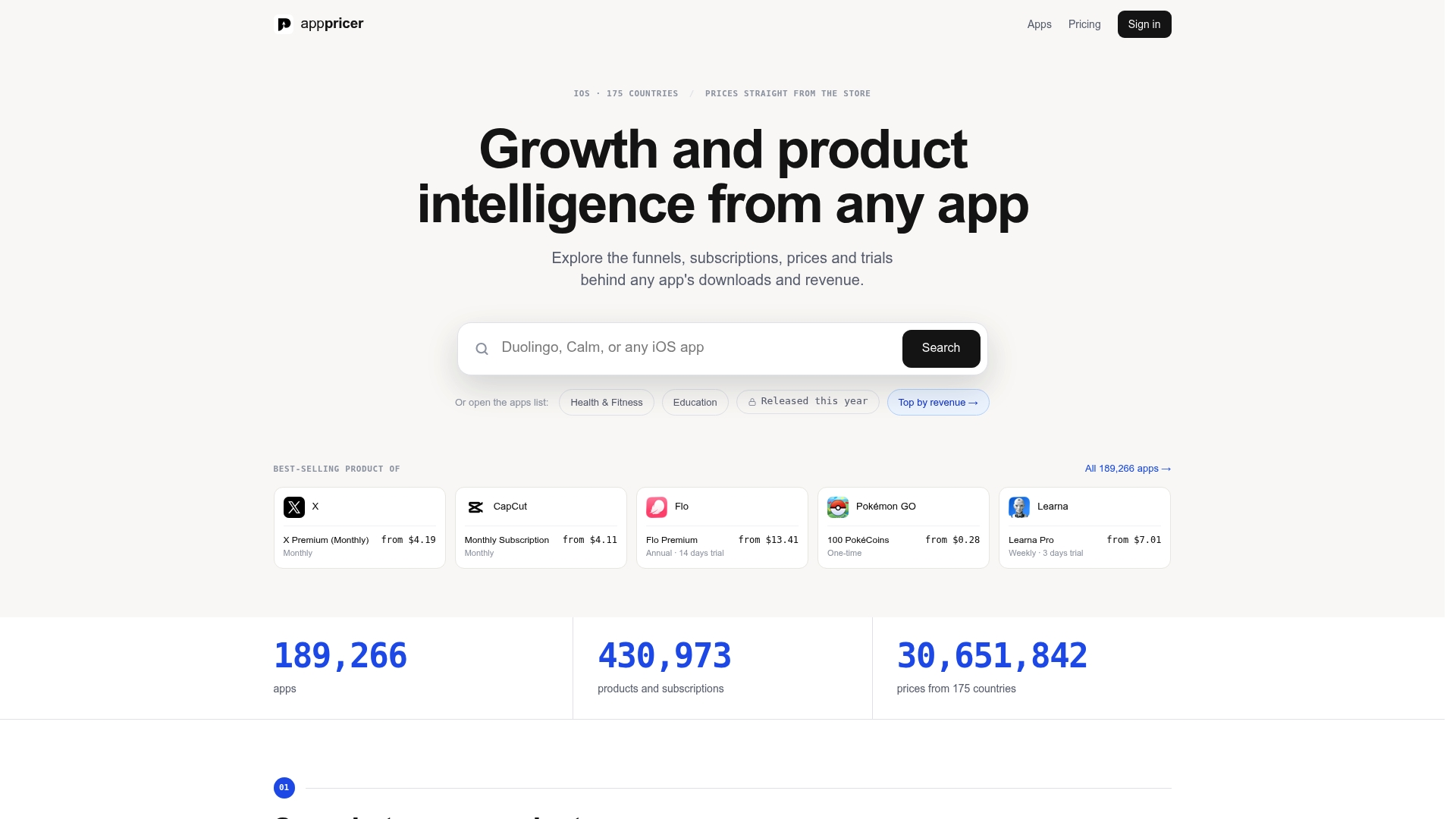
Apppricer tracks live app pricing, subscription structures, and revenue trends across 175 countries, which means you can see exactly what competitors in your category charge before you decide whether a payment re-architecture, a Small Business enrollment, or a straight subscription-price adjustment gets you further. Instead of modeling Scenario C in the abstract, pull real country-level pricing data for apps in your niche and run the comparison against your own proceeds. Start by browsing current app pricing and subscription data for your category, then use apppricer’s revenue projections to test whether a distribution change actually pays back faster than simply adjusting your pricing tiers.
Frequently Asked Questions
What is the standard Apple commission rate in 2026?
Do I need to reapply for the Small Business Program every year? Yes. Eligibility is checked annually against your prior-year proceeds across all Associated Developer Accounts, and you’ll revert to the standard rate if you exceed $1 million.
How do the new EU rates compare to the old Core Technology Fee? The EU overhaul replaced the flat Core Technology Fee with a 5% Core Technology Commission and tiered rates from 5% to 26% depending on distribution method, which can raise or lower your effective cost depending on your growth trajectory.
Can US developers link to external payment pages right now? Some external-link activity is currently permitted following Epic v. Apple rulings, but the legal status is unsettled while the Supreme Court docket remains active, so treat it as temporary.
Does the subscription discount require enrollment in any program? No.
Sources
- App Store Small Business Program
- Apple announces changes for apps in the European Union
- Apple overhauls App Store fees in the EU with new unified terms - CNBC