See Prices in 175 Countries: App Market Trends 2026 for Product Teams

On-device AI and multi-platform monetization will decide who wins the app economy in 2026, not who ships the most features. Teams that test flexible pricing, build web-to-app funnels, and instrument signal engineering now will outgrow rivals stuck on last cycle’s playbook. The immediate move: pick one AI-native feature, one pricing experiment, and one distribution test, then benchmark against real competitor data through a tool like Apppricer before committing budget.
TL;DR:
- On-device AI foundation models from Apple and Google run offline, reducing costs and making generative AI features expected in most categories by 2026.
- Pricing experiments such as weekly billing, usage-based charges, and regional tests are crucial, as revenue growth now depends more on monetization structure than feature volume.
- Privacy-enhancing features like passkeys and local AI processing are becoming standard, with apps focusing more on user trust and data minimization.
- Building flexible, data-driven testing methods and measurement KPIs, especially signal quality and efficiency metrics, will be key to sustainable growth in 2026.
Table of Contents
- App Market Trends 2026: The 7 Shifts That Actually Matter
- How Should You Price and Monetize Apps in 2026?
- Where Will App Installs Actually Come From in 2026?
- What Technical Choices Matter Most for 2026 Apps?
- Which KPIs Should Analysts Track in 2026?
- A 5-Step Playbook for the Next 6 Months
- Impact of 5G and Emerging Network Technologies on App Performance
- Trends in App Security and Data Privacy Beyond Compliance
- The Rise of AR and VR Integration in Apps
- Shifts in User Engagement and Retention Since 2026
- The Influence of Blockchain and Decentralized Tech on App Ecosystems
- What This Means for Your 2026 Roadmap
- How Apppricer Helps You Act on These Trends
- Sources
App Market Trends 2026: The 7 Shifts That Actually Matter
The global mobile app market is on track to grow at a compound annual rate of roughly 14.3% between 2024 and 2030, pushing total value toward $626 billion by 2030. That growth isn’t evenly distributed. Asia Pacific alone accounted for a significant share of revenue in 2023, and the gap between category leaders and everyone else keeps widening as downloads slow but spending per user climbs.
Here’s what’s driving the reshuffle for 2026:
- On-device AI as baseline. Apple and Google now ship foundation models that run offline with no per-call cost, and generative AI features have moved from novelty to expectation in most major categories.
- Web-to-app funnels replacing pure store discovery. Roughly 82% of top-grossing apps already rely on web funnels to acquire and convert users outside app store constraints.
- Monetization fragmenting. Flat monthly subscriptions are evolving into various models including weekly billing, credit systems, and hybrid trial structures tuned by region.
- Regulatory and distribution shake-ups. The EU’s Digital Markets Act and expanding link-out payment rights are forcing a rethink of commission-dependent pricing.
- Emerging markets accelerating faster than mature ones. Southeast Asia, Latin America, and parts of Africa are growing app spend faster than saturated Western markets.
- Privacy-first measurement replacing granular tracking. Signal engineering, not raw data volume, now determines ad efficiency.
- Revenue concentration among fewer winners. Growth increasingly comes from ARPU and subscription depth rather than new install volume.
Each of these compounds. A weak funnel undermines even the best AI feature; poor localization wastes a strong pricing test. Treat them as a single system, not a checklist.
How Should You Price and Monetize Apps in 2026?
Pricing strategy in 2026 needs to move faster than annual planning cycles allow. The apps growing revenue fastest aren’t necessarily adding features. They’re running structured pricing experiments and reading the results against real market benchmarks instead of gut instinct.
Build your experiment matrix around four variables:
- Trial length — 3-day trials often convert differently than 7-day trials depending on category; test both against your churn curve.
- Billing cadence — weekly subscriptions are gaining ground in categories like fitness and dating, where users want lower commitment friction.
- Credit and usage-based pricing — AI-heavy apps increasingly charge per generation or per action rather than flat access.
- One-time purchases — still viable in utility and productivity categories where subscription fatigue runs high.
Link-out payment routes change the math entirely. When a checkout happens outside the app store, you avoid the standard commission, but you take on payment processing, fraud handling, and customer support that the platform used to absorb. Run the link-out experiment on a small user segment before rolling it out broadly, and model the net margin, not just the gross savings.
Regional price sensitivity varies more than most teams assume. A price point that converts well in the US can flop in Southeast Asia without local payment method support, and vice versa.
Pro Tip: Before setting a price for a new market, pull competitor pricing snapshots for that exact country. Apppricer’s app data shows what similar products actually charge across 175 countries, which beats guessing based on your home market’s numbers.
Where Will App Installs Actually Come From in 2026?
App store search is no longer the only front door, and treating it that way leaves acquisition control on the table. Web-to-app funnels let you run creative tests in hours instead of waiting on app store review cycles, and they give you first-party data the stores never hand over.
That control matters more as attribution gets harder. A funnel you own end-to-end means you know exactly which ad, headline, or landing page drove the install, not an estimate filtered through platform black boxes.
Priorities for the next two quarters:
- Build a web landing page that mirrors your core in-app value proposition, then A/B test it against direct store traffic.
- Refresh App Store and Google Play creative sets quarterly, with localized preview videos for your top five markets.
- Test a small creator or ambassador program against paid user acquisition in one category to compare cost per install and retention quality.
- Localize onboarding copy and pricing display for at least two new markets, not just translation but currency, payment method, and cultural framing.
Paid UA still works, but it’s getting more expensive relative to organic and community-driven channels for apps with genuine word-of-mouth potential.
What Technical Choices Matter Most for 2026 Apps?
Engineering decisions made this year will lock in cost structure and development speed for the next two to three years, so treat them as strategic, not just technical.
On-device versus cloud AI comes down to a simple tradeoff: on-device models push recurring inference costs toward zero for frequent, simple features, while complex reasoning tasks still often need cloud models. Most production apps in 2026 route intelligently between the two rather than picking one architecture exclusively.
Passkeys are becoming the expected login method, cutting phishing risk significantly. The catch: account recovery becomes the new support burden, since losing a device without a backup method locks users out entirely.
Key technical calls for the roadmap:
- Default to on-device AI for anything run frequently (autocomplete, filters, quick summaries); reserve cloud calls for deep reasoning or personalization.
- Roll out passkeys with a mandatory backup recovery flow tested before launch, not after support tickets pile up.
- Build offline-first only where genuinely required (field service, travel, low-connectivity regions); retrofitting it later costs far more than designing for it up front.
- Choose Kotlin Multiplatform or Flutter for apps prioritizing speed across platforms; go native only when performance or platform-specific APIs are non-negotiable.
Pro Tip: Don’t retrofit offline-first support as an afterthought. It’s one of the most expensive architecture changes to bolt on after launch, often requiring a near-total rebuild of your data sync layer.
Which KPIs Should Analysts Track in 2026?
Privacy constraints have made raw tracking data less reliable, which means the KPIs worth watching have shifted from volume metrics to efficiency and signal quality.
| Metric | What it tells you | Why it matters in 2026 |
|---|---|---|
| ARPDAU | Daily revenue efficiency per active user | Reveals monetization health independent of install volume |
| LTV:CAC ratio | Whether acquisition spend pays back | Rising CAC makes this the core go/no-go metric for UA |
| Funnel conversion by step | Where users drop before purchase | Web funnels expose steps app stores hide |
| Payment failure/retry rate | Lost revenue from broken checkout | Optimized retries and upsells can add 10 to 20% to LTV |
Signal engineering, choosing which events you feed to ad platforms as optimization goals, now matters more than creative testing alone for teams spending five figures monthly on UA. Pair that with incrementality testing or marketing mix modeling to confirm your paid spend is actually driving results, not just correlating with organic growth already happening.
A 5-Step Playbook for the Next 6 Months
Analysis without execution is just a slide deck. Here’s the sequence that turns everything above into results:
- Ship one AI-native feature fast. Pick a single “aha” moment powered by on-device AI and measure activation lift within 30 days.
- Build and test a web-to-app funnel. Run it against your current in-app checkout for at least 1,000 conversions before deciding which wins.
- Run a localized pricing experiment. Test weekly billing or credit pricing in one region before rolling it globally.
- Instrument signal engineering. Redefine your optimization events and run a formal incrementality test alongside your existing UA spend.
- Localize for one or two emerging markets. Match payment methods and pricing display to local expectations, not just translated text.
Pro Tip: Run these steps in parallel, not sequence. A pricing test and a funnel test rarely interfere with each other, and running them together compresses your learning cycle by months.
Impact of 5G and Emerging Network Technologies on App Performance
Faster networks change what “acceptable” performance means for users, and that bar keeps rising every year. Where 4G made streaming and light AI features viable, 5G’s lower latency and higher throughput make real-time features, like live AR overlays, multiplayer sync, and cloud-rendered graphics, feel instant rather than laggy.
This matters most for categories that were previously bottlenecked by network speed: cloud gaming, video-heavy social apps, and any experience blending on-device AI with cloud fallback. When the cloud round-trip drops from 200 milliseconds to under 50, hybrid AI architectures that route complex requests to the cloud become far more viable without hurting perceived responsiveness.
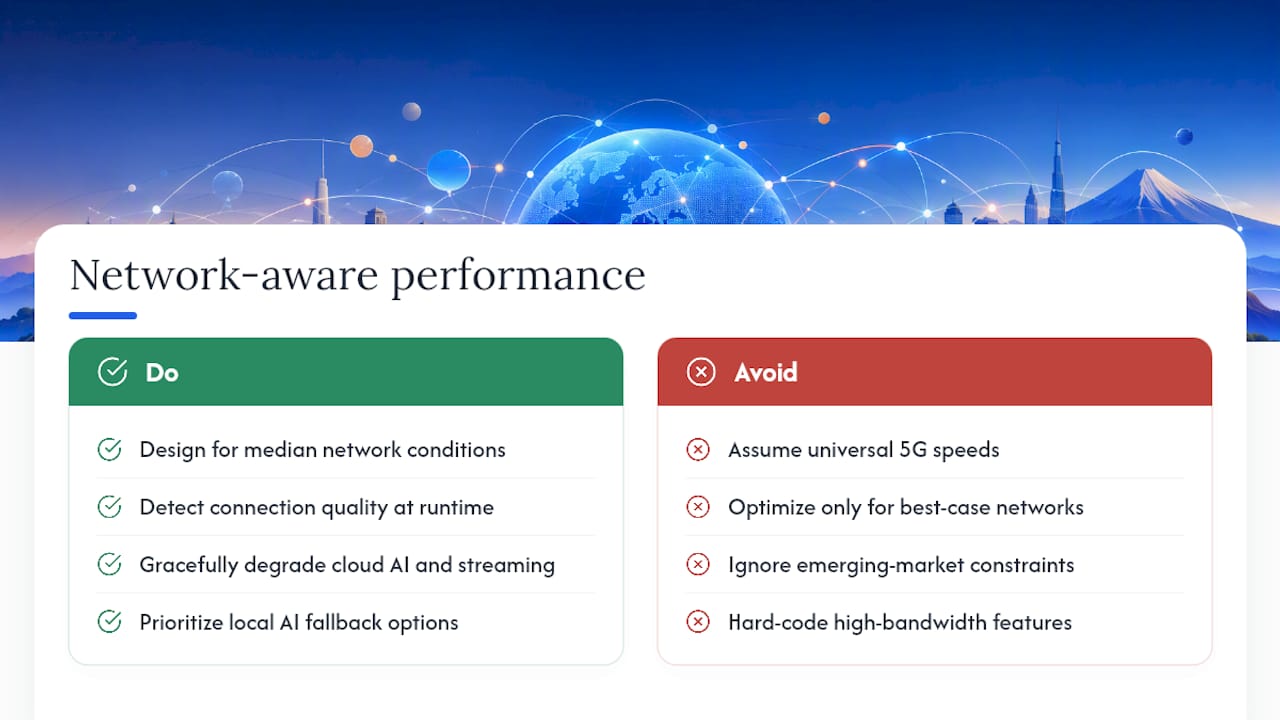
The rollout isn’t uniform. 5G coverage still varies enormously by country and even by neighborhood, which means apps built assuming universal 5G speeds will disappoint a meaningful share of users, particularly in emerging markets where 4G remains dominant for longer. Build your performance baseline around the median network condition in your target markets, not the best case.
Early 6G research is already shaping network equipment roadmaps, but for 2026 planning purposes, 5G maturity and consistent coverage gaps are the practical constraint. Design your app to detect connection quality and gracefully degrade, dialing back cloud AI calls or streaming quality, rather than assuming a fast connection everywhere.
Trends in App Security and Data Privacy Beyond Compliance
Regulatory compliance sets the floor, not the ceiling, and users increasingly notice the difference. Apps that treat privacy as a checkbox exercise are losing trust to competitors that build it into the product experience itself.
Passkey adoption is the clearest security shift for 2026, replacing password-based logins with device-bound cryptographic credentials that are dramatically harder to phish. The tradeoff, as noted earlier, is that account recovery becomes the new operational challenge; teams need robust fallback flows before they can responsibly push passkeys as the default.
On-device AI processing offers a privacy dividend beyond cost savings: when inference happens locally, sensitive data never leaves the device, which sidesteps a whole category of data-handling risk and simplifies compliance conversations. This is becoming a marketing differentiator in categories handling health, financial, or personal data.
Beyond authentication and processing location, expect more apps to publish plain-language privacy summaries alongside their formal policies, adopt data minimization by default rather than by request, and build user-facing controls that let people see and delete their own data without submitting a support ticket. None of this is legally required everywhere, but it’s becoming a competitive expectation in markets where users have grown wary of data misuse headlines.
The Rise of AR and VR Integration in Apps
Augmented and virtual reality features have moved from experimental add-ons to functional utility in specific categories, and 2026 is the year that shift becomes visible in mainstream apps rather than just gaming and social novelty.
Retail and furniture apps use AR for product visualization, letting users see how an item looks in their actual space before buying, which measurably reduces return rates in categories where fit and appearance drive purchase decisions. Education and training apps use AR overlays for step-by-step physical instruction, from assembly guides to medical training simulations.
VR’s growth is more concentrated. Fitness, immersive gaming, and enterprise training (flight simulation, hazardous equipment operation) remain the categories where VR headset adoption justifies dedicated app investment. Consumer VR outside gaming still faces a hardware adoption ceiling that limits how broadly a mainstream app should invest in it.
The practical question for most teams isn’t whether to build a VR app, it’s whether an AR feature inside an existing app can solve a real friction point. Camera-based AR features (try-before-you-buy, measurement tools, navigation overlays) require far less investment than a standalone AR/VR product and reach users who already have your app installed. Prioritize AR-as-a-feature over AR-as-a-product unless your category (gaming, immersive training) specifically demands the latter.
Shifts in User Engagement and Retention Since 2026
Retention strategy built around daily login streaks and push notification volume is losing effectiveness as users grow numb to both. What’s replacing it is retention built around value delivered per session rather than frequency of visits.
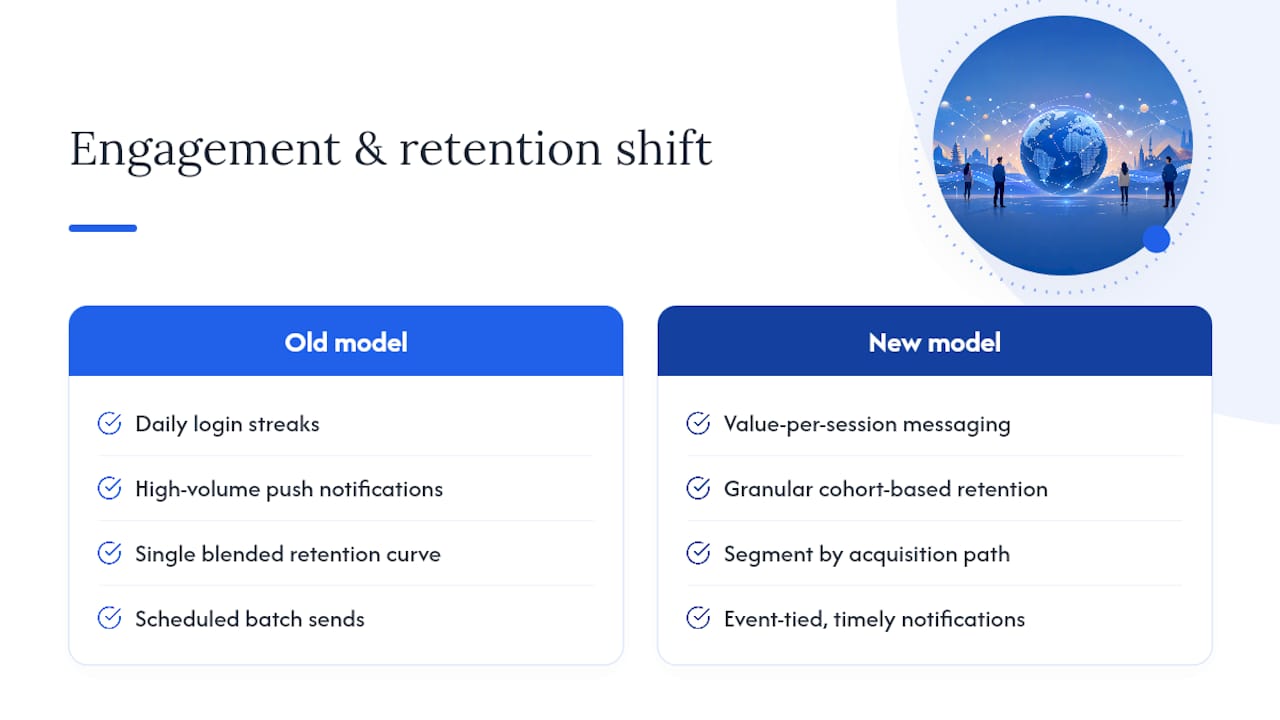
Apps that shifted from “come back every day” messaging to “here’s what changed since you left” messaging report stronger reactivation, because the message respects that not every user needs daily engagement to find the app valuable. This matters especially for utility and finance apps, where forced daily engagement often feels manipulative rather than useful.
Cohort-based retention analysis has become more granular. Instead of a single blended retention curve, teams increasingly segment by acquisition channel, onboarding path, and first-session behavior, because a user acquired through a web funnel behaves differently than one acquired through app store search. Treating them identically in retention campaigns wastes budget on messaging that doesn’t fit how they arrived.
Notification strategy is also shifting toward fewer, better-timed messages tied to genuine account activity (a price drop, a friend’s action, a milestone) rather than scheduled batch sends. The apps winning retention in 2026 tend to earn re-engagement through relevance, not remind users through repetition.
The Influence of Blockchain and Decentralized Tech on App Ecosystems
Blockchain’s role in mainstream apps has narrowed rather than expanded since its early hype cycle, and 2026’s practical use cases look different from what was predicted a few years back.
Consumer-facing crypto wallets and NFT marketplaces remain a niche category rather than a mainstream feature expectation. Where decentralized technology genuinely shows up in app strategy is quieter: decentralized identity systems that let users prove credentials without a central authority holding the data, and blockchain-based provenance tracking in supply chain and luxury goods apps where authenticity verification has real commercial value.
Gaming remains the category most actively experimenting with token-based ownership models, letting players genuinely own in-game assets across titles, though regulatory uncertainty around these mechanics varies significantly by country and keeps many studios cautious.
For most app categories outside gaming, finance, and specific B2B verticals like supply chain, blockchain integration in 2026 is a distraction from higher-leverage priorities like AI features and monetization testing. The realistic move for most teams is to monitor decentralized identity standards as they mature rather than building blockchain features speculatively.
What This Means for Your 2026 Roadmap
The apps winning in 2026 aren’t necessarily the most technically ambitious. They’re the ones running disciplined pricing experiments and reading market data instead of assuming last year’s model still works. Apppricer’s own data across 175 countries backs this up consistently: the biggest revenue swings we see aren’t from feature launches, they’re from pricing structure changes that teams tested deliberately rather than copied from a competitor.
Where I’d caution against over-investing: standalone VR products outside gaming and enterprise training, and blockchain features for categories with no clear ownership or provenance use case. Both get outsized attention relative to their actual revenue impact for most app businesses right now.
— Sergey
How Apppricer Helps You Act on These Trends
Every trend in this article points to the same requirement: test pricing and positioning against real market data before committing budget. Apppricer tracks actual app prices, subscription structures, revenue projections, and download trends across 175 countries, so you can see exactly what’s working for competitors in your category before you copy or diverge from their approach.
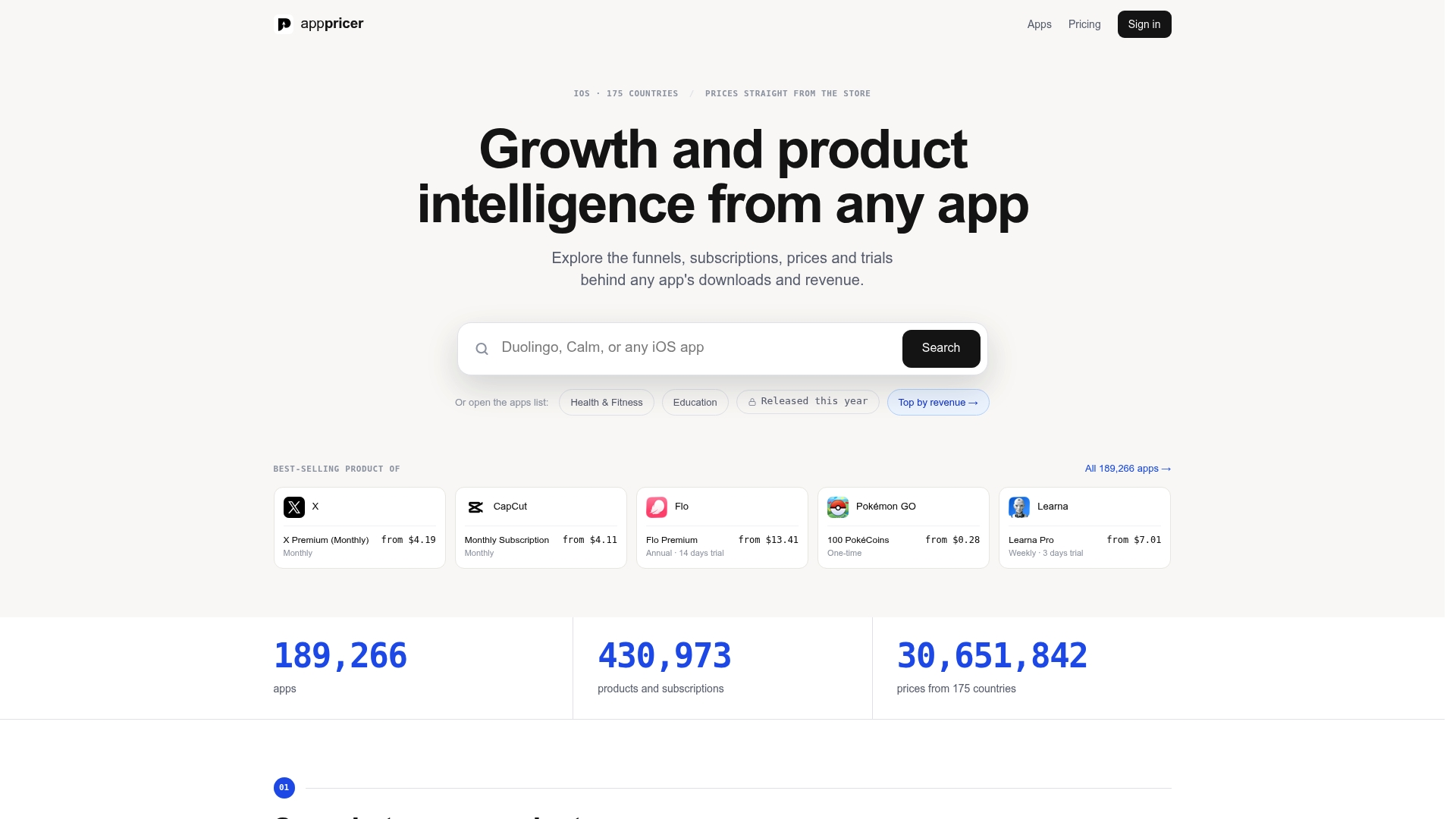
Use it to set a starting price benchmark for a new market, check whether a competitor’s weekly billing test is outperforming their old monthly plan, or spot a niche where pricing gaps suggest room to enter profitably. Browse iOS app pricing and subscription data for your category to see how leaders structure trials, tiers, and regional pricing right now, then set your own experiment matrix based on what’s actually converting rather than what sounds reasonable in a planning meeting.
Sources
- App market trends 2026: The year ahead according to experts
- Mobile Application Market Analysis — Grand View Research
- State of Mobile Apps 2026: Key Trends & Statistics — Appalize