Should You A/B Test Pricing? Here’s the Direct Answer

Run a pricing A/B test only if you have transactional or subscription volume high enough to reach significance in a reasonable window; if you sell through negotiated or low-volume B2B deals, skip raw price splits entirely. The safest first experiment isn’t a price change at all. It’s a presentation test: highlighting a tier, changing the default billing cycle, or reframing the same price per unit instead of per month. If you do test actual price points, show different prices only to new visitors, never existing customers, and judge the winner by revenue per visitor (RPV) or proceeds-per-user, not conversion rate alone.
A few operational realities to keep in mind before you touch a price field:
- Billing systems need to handle multiple live price points without breaking renewals or reporting.
- Finance needs to reconcile proceeds net of store fees and taxes, not gross sticker price.
- Customer-facing teams need a script ready in case someone notices a friend paying less.
Quick take: the entire discipline of price experimentation collapses if you optimize for signups instead of net revenue. A cheaper price almost always converts more people. Whether it makes more money is the actual question.
Key Takeaways
Pricing A/B tests only produce trustworthy results when teams measure revenue per visitor, restrict raw price changes to new visitors, and treat conversion-rate wins as suspect until churn and refunds confirm them.
| Point | Details |
|---|---|
| Match the environment | Run raw price tests only in transactional or subscription products with enough volume; skip them for negotiated B2B deals. |
| Lead with presentation | Test badges, defaults, and framing before touching price points to find lower-risk revenue lifts. |
| Judge by RPV, not conversion | Use revenue per visitor or proceeds-per-user as the primary metric, net of fees and refunds. |
| Give it enough time | Run transactional tests at least two weeks and subscription tests roughly two billing cycles. |
| Ground hypotheses in real data | Apppricer’s cross-country pricing and subscription data helps teams set price bands from actual market behavior instead of guesswork. |
Where to Go Next for Implementation Details
Consult Google Play’s price experiment documentation for exact platform constraints on variants and duration before configuring a mobile test. Read Stripe’s pricing experiments guide for a broader framework on when randomized testing applies. Review Brillmark’s breakdown of price A/B testing for the statistical reasoning behind RPV as a decision metric, and Kirro’s practical guide for churn-window analysis after a test ships.
Table of Contents
- What Environments Make A/B Test Pricing Valid?
- How Do You Design a Valid Pricing Experiment?
- Which Metrics Actually Prove a Pricing Test Won?
- Test Presentation Before You Touch the Price
- How Long Should You Run a Pricing A/B Test?
- What Legal and Ethical Limits Apply to Pricing Tests?
- An 8-Step Runbook for Running a Pricing Test
- How Apppricer’s Data Supports Defensible Pricing Experiments
- Real Pricing Test Outcomes Worth Studying
- How Do You Handle Customer Backlash During a Price Test?
- Apppricer: Skip the Guesswork on Your Next Price Band
- Sources
What Environments Make A/B Test Pricing Valid?
Three commercial environments determine whether A/B testing pricing will actually give you a trustworthy answer, and most teams skip this check before building anything.
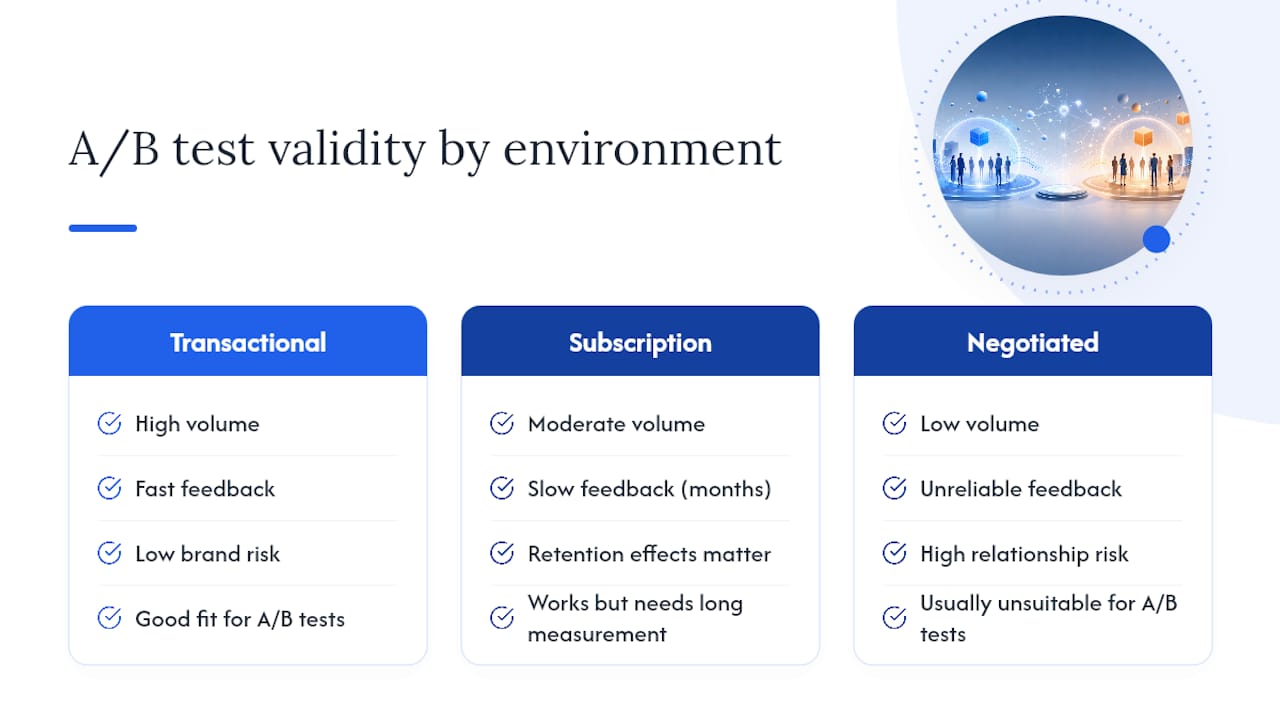
Transactional commerce (one-time purchases, in-app consumables, single-use unlocks) is the friendliest environment. Volume is usually high, feedback loops are fast, and a bad variant can be killed in days.
Subscription and self-serve products (freemium apps, SaaS tools, content subscriptions) work well too, but you’re measuring a longer arc, since a price change affects trial conversion now and retention months later.
Negotiated or relationship sales (enterprise contracts, sales-assisted deals, anything with a human quoting a custom number) is where randomized price testing usually breaks down. You don’t have the deal volume for statistical power, and a prospect discovering another client got a lower quote creates real relationship damage. Stripe’s guidance on pricing experiments notes that low-traffic apps and negotiated B2B contracts often lack the statistical reliability needed for raw price splits, and carry more brand risk when they go wrong.
Before running anything, check your operational dependencies: how many SKUs need separate variants, how many legacy subscribers are grandfathered into old pricing, and whether regional pricing rules (VAT-inclusive pricing in the EU, for instance) constrain which countries can even participate.
Pro Tip: If your monthly active paying users are under a few thousand, don’t force a price test. Run a presentation test instead. You’ll learn almost as much with a fraction of the risk.
How Do You Design a Valid Pricing Experiment?
A pricing experiment lives or dies on assignment logic, not on the price points you pick. Get the mechanics wrong and your “winner” is noise wearing a lab coat.
Start with a hypothesis that names the metric, not just the price.
Here’s the build sequence:
- Pick control and variant prices based on real market comparables, not gut feel. This is where checking what competing apps actually charge across regions saves you from picking an arbitrary number.
- Randomize assignment at the user or session level, using a deterministic hash (user ID, device ID) so the same person always lands in the same bucket across sessions.
- Restrict absolute price changes to new visitors only. Existing users seeing a different price than what they signed up for is where pricing tests turn into support tickets and public complaints.
- Implement sticky assignment so a returning visitor sees the same variant every time, not a new random roll on each visit.
- Tag every event (view, trial start, purchase, refund) with the variant ID before launch, not after someone asks why the dashboard doesn’t segment cleanly.
- Map every SKU or product ID to its variant explicitly. Silent SKU drift is one of the most common causes of contaminated pricing tests.
- Write a rollback plan and assign someone to own it. If churn spikes in week one, someone needs the authority to kill the test without a committee vote.
Pro Tip: Loop in billing and finance before writing a single line of test code. A test that generates revenue findings finance can’t reconcile against actual invoices is a test you’ll have to run again. Tools like Firebase’s A/B Testing product can handle the variant delivery mechanics, but the reconciliation work is still yours.
Which Metrics Actually Prove a Pricing Test Won?
Revenue per visitor, sometimes called proceeds-per-user, should be your primary decision metric. Not conversion rate. A lower price will almost always convert more people; the question is whether the extra volume covers the lower ticket size. Brillmark’s analysis of price experimentation makes this point directly: conversion rate alone can mislead, because higher conversion at a lower price can still shrink net revenue per visitor.
Calculate RPV as total revenue divided by total visitors exposed to a variant, and make sure “revenue” means proceeds after store fees, payment processing costs, and refunds, not the sticker price. A 30% relative RPV gap can evaporate once you subtract a 15 to 30% app-store commission that only hits one variant differently because of currency or tax handling.
A few statistical guardrails matter more in pricing tests than in typical UI tests:
- Define your minimum detectable effect (MDE) before launch. A test that can only reliably detect a 15% RPV swing isn’t built to catch the 5% differences that matter in mature markets.
- Use confidence intervals, not just a binary p-value pass/fail. A 4% lift with a wide interval spanning zero isn’t a result yet.
- Correct for multiple comparisons if you’re running more than one variant against control. Testing three price points simultaneously without adjustment inflates your false-positive rate.
Then check the metrics that reveal a fake winner: 30/60/90-day churn, refund rate, and support ticket volume. A price increase that lifts RPV but doubles refund requests in month one isn’t a win. It’s a delayed loss.
Test Presentation Before You Touch the Price
Before splitting raw price points, test how the price is presented. It’s usually less risky and often more profitable. A “Most Popular” badge on your mid-tier plan, an annual plan set as the default toggle instead of monthly, decoy pricing that makes your target tier look like the obvious choice, or reframing a subscription as “$0.33 a day” instead of “$9.99 a month” can all shift revenue meaningfully without a single customer noticing a price discrepancy.

Unbounce’s research on pricing experiments found that presentation changes frequently produce high-impact lifts, often outperforming direct price-point tests while carrying far less brand and reputational risk.
Quick take: presentation changes touch how people perceive value; price changes touch what they actually pay. One is reversible with zero customer-facing fallout. The other is a story your support team has to explain.
Recommended test sequence:
- Presentation and framing first (badges, defaults, unit framing).
- Packaging second (what’s bundled into each tier).
- Raw price points last, and only once the first two have been exhausted.
How Long Should You Run a Pricing A/B Test?
Run transactional price tests for a minimum of two weeks to capture a full weekly cycle of buyer behavior, including weekend versus weekday differences. For subscription products billed monthly, plan for roughly 60 days, covering two full billing cycles, so you can see whether the price holds up past the honeymoon conversion window.
Pricing tests generally need larger sample sizes than typical UI experiments, because revenue metrics have far more variance than click-through or signup rates. A handful of high-value purchases can swing your RPV number in ways a binary “did they click” metric never would. Before launch, estimate your MDE and back-calculate the visitor count needed to detect it at your chosen confidence level. If the math says you need six months of traffic to detect a 5% lift, either widen the price gap between variants or accept you’re testing for a bigger effect.
If you’re testing inside the Google Play ecosystem, the platform itself sets hard limits: Google Play caps experiments at two variants plus a control, stops the experiment automatically 14 days after reaching statistical significance, caps total length at six months, and blocks overlapping experiments in the same country.
Rule of thumb: if your platform’s auto-stop triggers before you’ve hit your pre-calculated sample size, treat the result as directional, not conclusive.
What Legal and Ethical Limits Apply to Pricing Tests?
Pricing experiments sit closer to legal exposure than most product tests, and the rules differ by jurisdiction, so treat this section as a starting checklist, not a substitute for legal review.
Never let a price difference correlate with protected characteristics like race, religion, gender, or age, even indirectly through proxy data such as zip code in some jurisdictions. That’s not a gray area in most consumer-protection frameworks; it’s a direct violation. Some countries and states also have specific rules around personalized or dynamic pricing disclosure that your legal team needs to check before you launch across a new region.
Don’t silently change prices for existing customers. If you must adjust pricing for a current subscriber base, presentation tests or explicit advance notice are the safer path. Quietly billing two existing customers different amounts for the same product is the fastest route to a public complaint and a chargeback spike.
Operationally: document every test’s hypothesis, variants, and dates; keep an audit trail of who approved it; consult legal counsel for region-specific consumer pricing rules before expanding geography; and always have a rollback plan ready before launch, not improvised after backlash starts.
An 8-Step Runbook for Running a Pricing Test
Most failed pricing tests fail before the first user ever sees a variant. Here’s the sequence that catches problems early:
- Define the objective and decision metric. Commit to RPV or proceeds-per-user as your primary metric before you pick a single price point.
- Research price bands. Look at what comparable apps in your category and region actually charge, not what a spreadsheet formula suggests.
- Write the hypothesis. Name the price change, the expected RPV shift, and the guardrail metric (churn, refunds) that could veto a win.
- Configure variants and assignment. Set deterministic, sticky assignment restricted to new visitors.
- Validate telemetry before launch. Confirm every purchase, refund, and churn event carries a variant tag. Fix this now, not during analysis.
- Run with active monitoring. Watch refund rate and support volume daily during the first week, not just at the end of the test.
- Analyze RPV alongside downstream metrics. A positive RPV result with rising 30-day churn isn’t a winner yet; reconcile the two before deciding.
- Ship the winner and reconcile billing. Update the default price, migrate new signups, and confirm finance’s reporting matches what the test actually measured.
A useful decision threshold template: require at least a 3 to 5% RPV uplift with statistical confidence and no material increase in 30-day churn before shipping. Anything smaller than that is usually noise dressed up as a signal.
Pro Tip: Set your rollback trigger before launch, not during a crisis. “If refund rate exceeds X% in week one, we revert” written down in advance removes the panic-vote later.
After shipping, don’t walk away. Reconcile billing systems against the new price, send any required customer communications, and keep watching refund and churn dashboards for at least one more full cycle. Winners sometimes decay.
How Apppricer’s Data Supports Defensible Pricing Experiments
Forming a pricing hypothesis from guesswork is how most bad tests start. Apppricer tracks actual app pricing, revenue, and download trends across 175 countries, giving product and growth teams a real market baseline instead of an arbitrary starting number.
That matters most in two places:
- Setting price bands. Instead of testing $9.99 versus $12.99 because it “felt reasonable,” teams can check what comparable apps in the same category and country actually charge, then set variants around real market clustering.
- Regional banding. A price that works in the US market often doesn’t translate directly to a market with different purchasing power. Apppricer’s country-level breakdowns help teams avoid running a US-calibrated price test in a region where it was never going to hold up.
- Replicating proven models. The platform aggregates real subscription structures, not estimated ones, so teams can model a hypothesis on what’s already working in the category rather than reverse-engineering it from scratch.
Cross-functional friction between growth, billing, and finance kills more pricing tests than bad statistics do. Grounding the hypothesis in real market data before the first line of code gets written removes one entire category of argument before it starts.
Real Pricing Test Outcomes Worth Studying
The most instructive pricing tests rarely involve dramatic price swings. They involve a narrow, well-measured change that revealed something counterintuitive about how buyers actually behave.
Consider a subscription app that tested moving its annual plan from an opt-in toggle to the pre-selected default, while leaving the price itself untouched. The presentation change alone shifted plan mix meaningfully toward the higher-value annual commitment, exactly the kind of packaging test that Unbounce’s pricing research points to as often outperforming raw price splits.
Another common pattern shows up in apps that test price per unit versus price per period. Reframing a $19.99 monthly plan as roughly $0.66 a day, without changing the actual charge, tends to shift how prospects mentally categorize the expense, sometimes moving conversion at the trial stage even though nothing about the bill changed.
The pattern across defensible case studies is consistent: the team measured RPV, not just conversion; they watched churn for at least one full billing cycle before declaring a winner; and they were willing to call a “successful” conversion lift a failure once refunds or early cancellations ate into the gain. The tests that get remembered as wins a year later are the ones where someone checked the downstream number before popping the champagne.
How Do You Handle Customer Backlash During a Price Test?
Someone will notice. A support ticket, a screenshot on social media, a review mentioning “why is my friend paying less than me.” Plan the response before it happens, not during it.

Have a short, honest explanation ready for support teams: something like “we’re testing pricing options with new customers to make sure we’re offering the best value long term.” It doesn’t need to reveal experiment mechanics, but it needs to be true and consistent across every agent who might field the question.
The single biggest backlash risk is existing customers discovering a price difference that applies to them specifically. That’s why the restriction to new visitors matters operationally, not just statistically. If a current subscriber ever sees a different price than what they agreed to, the conversation shifts from “interesting experiment” to “why did you change my bill without telling me,” and that’s a much harder conversation to win.
If a price change does eventually roll out broadly, including to existing customers, give advance notice, explain what’s changing and why, and consider grandfathering loyal subscribers at their current rate for a defined period. Silence reads as deception even when the underlying test was reasonable. A little transparency, timed correctly, usually costs less than the trust you’d lose by skipping it.
A Few Things Teams Get Wrong About Pricing Tests
I keep seeing the same failure mode: growth wants to ship a price change fast, while billing and finance haven’t been looped in on how the test reconciles against actual invoices. The fix is boring but effective. Get finance in the room during hypothesis design, not after you have “results” they can’t validate.
— Sergey
Apppricer: Skip the Guesswork on Your Next Price Band
You don’t need three competitor screenshots and a hunch to set your test bands. Apppricer pulls real pricing, subscription structures, and revenue trends from apps across 175 countries, so your hypothesis starts from what buyers are actually paying today instead of what your last planning meeting guessed.
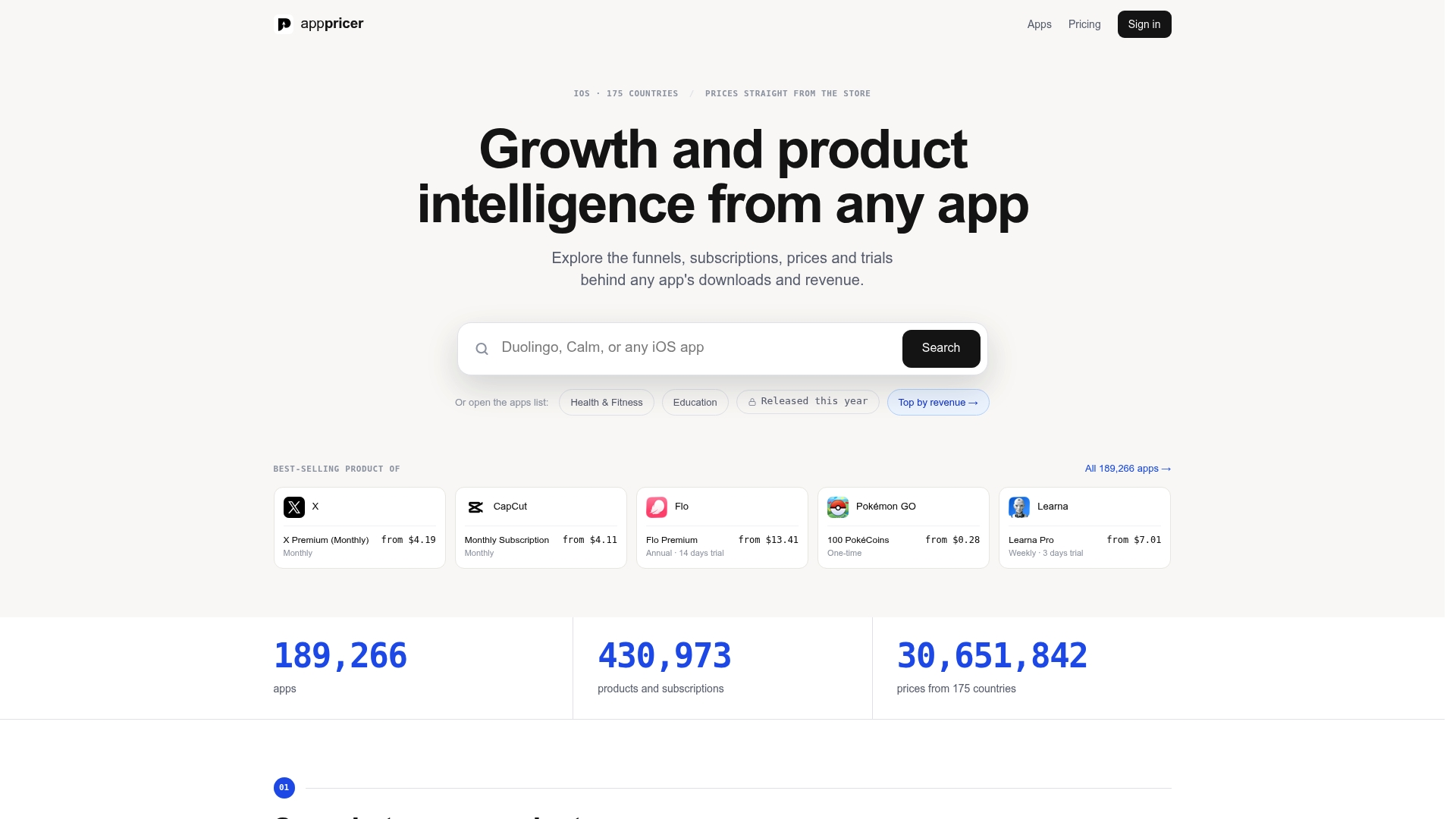
Growth teams typically use this to shortcut two of the hardest parts of a pricing test: picking defensible price bands for a control-versus-variant split, and estimating what proceeds actually look like once store fees and regional tax handling are factored in. Instead of running a test blind and hoping the price makes sense once results come in, you check what comparable apps in your category and country already charge, then build your variant around that real baseline.
If you’re planning your next pricing experiment, start by browsing current app prices and subscription models in your category to see where the market actually sits before you write your hypothesis.
Sources
- Pricing experiments: A guide for businesses | Stripe
- Run price experiments and apply variants - Google Play Console Help
- A/B testing for pricing: How to experiment with pricing
- All about price A/B testing & experimentation | Brillmark