Sightreading Exercises
No in-app products collected for this app.
| Rating | |||
|---|---|---|---|
| Japan | 37%67 | 4.52 | |
| China | 15%27 | 4.52 | |
| South Korea | 13%23 | 4.30 | |
| United States | 11%21 | 4.38 | |
| Taiwan | 6%11 | 4.27 | |
| United Kingdom | 5%9 | 4.89 | |
| Australia | 3%6 | 5.00 | |
| Canada | 2%4 | 4.25 | |
| Hong Kong | 2%3 | 3.33 | |
| Germany | 1%2 | 4.50 | |
| Mexico | 1%2 | 5.00 |
Description
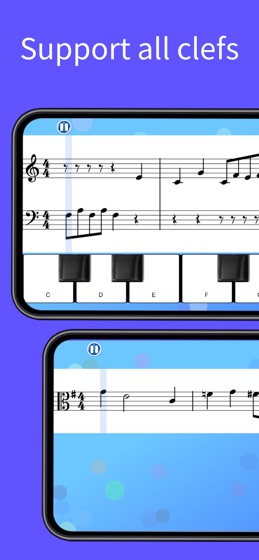
Customized for instruments, including full orchestra settings:
Piano, Violin, Viola, Cello, Double Bass, Guitar, Bass, Clarinet (Bb and A), Oboe, Bassoon, Flute, Piccolo, French Horn (double horn setting F / Bb), Trumpet (C / Bb), Saxophone (Soprano, Alto, Tenor, Baritone), Trombone (Tenor and Bass), Tuba, Harp.
Complete your entire music learning journey by practicing in different modes: Flash Cards, Music Theory, Full Flow Sheet Music, and Practice Real Songs.
Functions and settings available across different modes:
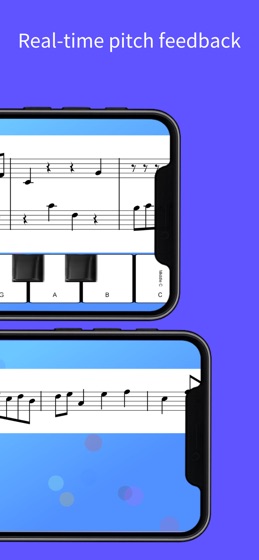
The app is able to show you the sheet music, listen to you play on your instrument, and provide feedback.
Even on grand stave with multiple notes at a time. This is called polyphonic detection system.
Melodic Randomness: control how random the generated notes are
Hints (instrument-specific)
Keyboard (Piano)
Fingerboard chart (Violin, Viola, Cello, Double Bass)
Fretboard chart (Guitar, Bass)
Fingering (Clarinet, Flute; more coming soon)
Pitch meter for intonation (Violin, Viola, Cello, Double Bass, Trombone)
Intonation accuracy check for microtonal instruments:
Green tick: perfect intonation
Yellow tick: Acceptable hit but slightly out of tune
Voice Control: restart the exercise without touching the screen
1. Flash Cards
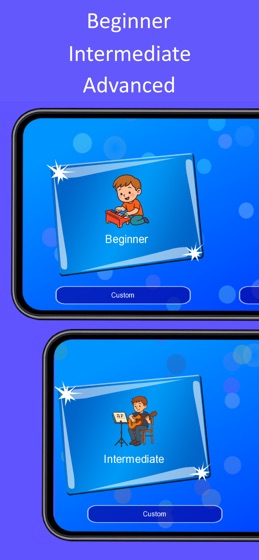
Levels 1 to 20 (beginner)
Levels 21 to 40 (intermediate)
Levels 41 to 60 (advanced)
Custom levels (12 keys, all accidentals including double-sharp and double-flat)
2. Music Theory
Scales
Major scales (12 keys, up to 3 octaves)
Harmonic minor and melodic minor scales (12 keys, up to 3 octaves)
Chromatic scales (adjustable range)
Chords (up to 3 octaves)
Major Triad, Minor Triad, Major Seventh, Minor Seventh, Dominant Seventh, Diminished Seventh, Augmented Triad, Diminished Triad,
Suspended Seventh, Suspended Second, Suspended Fourth, Major Ninth, Minor Ninth, Dominant Ninth, Added Ninth, Major Eleventh, Minor Eleventh,
Dominant Eleventh
Rhythms
Note types
Semibreve (Whole)
Minim (Half)
Crotchet (Quarter)
Quaver (Eighth)
Semiquaver (Sixteenth)
Rests
Dotted notes
Triplets
Time signatures
4/4, 2/4, 3/4, 6/4, 3/8, 6/8, 9/8, 12/8
3. Full Flow Sheet Music (practice sight-reading with real sheet music. Hit the right note, or practice playing in rhythm with the metronome)
Levels 1 to 20 (beginner)
Levels 21 to 40 (intermediate)
Levels 41 to 60 (advanced)
Custom levels (12 keys, 8 time signatures, 10+ note types, all accidentals including double-sharp and double-flat)
4. Practice Real Songs (over 160 famous songs by different composers)
Songs organized by
Albums (13 music books)
Composers (Beethoven, Mozart, Bach, Tchaikovsky, Haydn, Schubert, Schumann, Handel, Chopin, Liszt, Mendelssohn, Debussy, Bizet,
Brahms, Vivaldi, Johann Strauss, Paganini, Pachelbel, Czerny, Rachmaninoff, Scott Joplin, Clementi, Edvard Grieg,
Ravel, Scarlatti, Weber, Sibelius, Saint-Saëns, Verdi, Puccini, Rossini, Erik Satie, Nikolai Rimsky-Korsakov,
Antonín Dvořák, Edward Elgar, Jules Massenet, Richard Wagner, and more)
Grades (Grade 1 to 7)
Tools for day-to-day practice are also available:
Tuners
Full-range chromatic tuner: A0 to C8
Violin, Viola, Cello, Double Bass, Guitar, Bass, and tuners for transposing instruments, such as Clarinet, French Horn, Trumpet, and Saxophone
Metronome (classic metronome that lets you adjust BPM by sliding the pendulum weight up and down)